



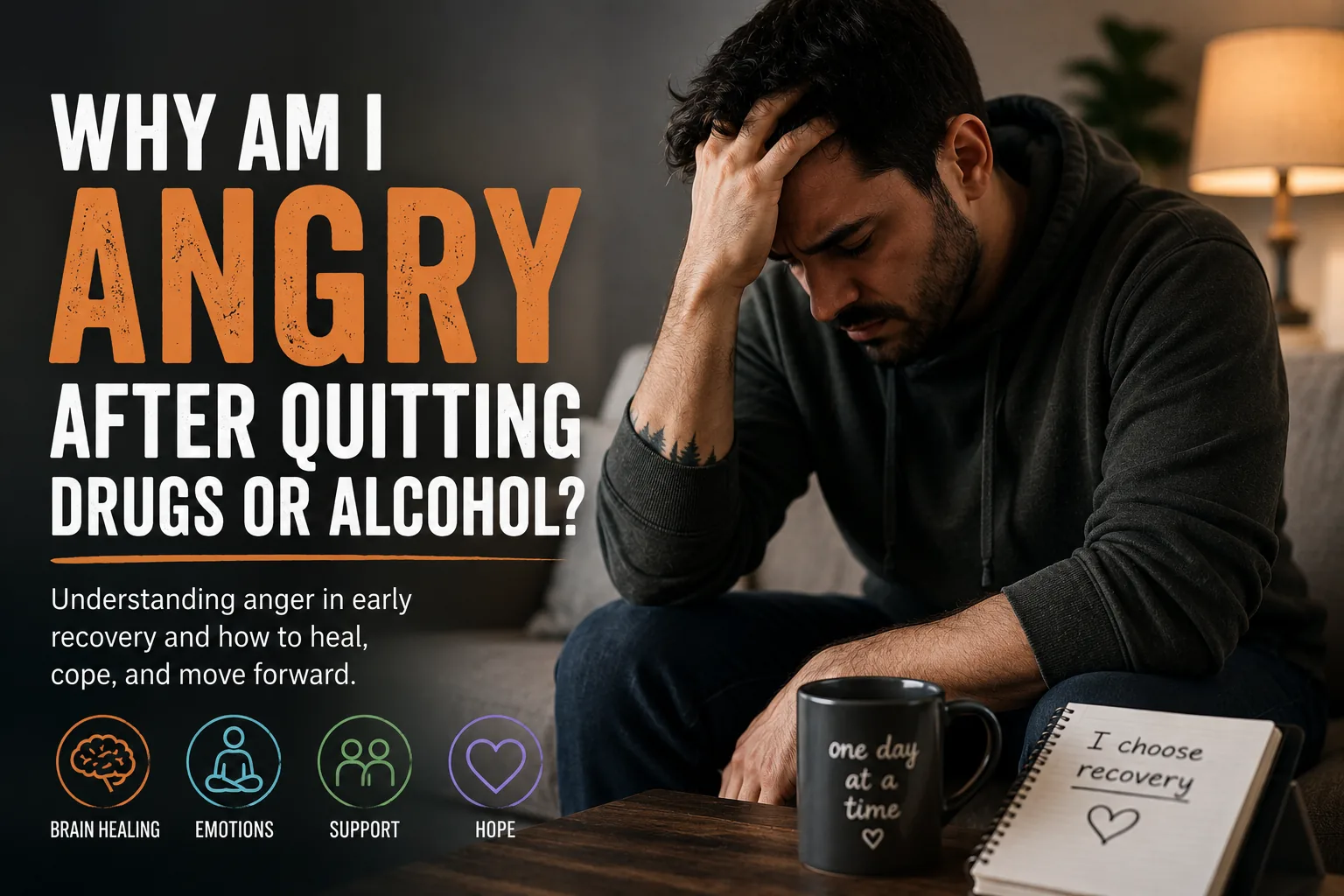


Why am I angry after quitting drugs or alcohol? If you recently stopped using and suddenly feel irritated by everything, you are not alone. Anger can be a surprisingly strong part of early recovery.
You may snap at people you care about.
Small problems can feel enormous.
You may have less patience at work, become frustrated in traffic, or feel angry that other people seem to be enjoying life while you are struggling just to stay sober.
Sometimes you may not even know what you are angry about.
Quitting drugs or alcohol removes the substance, but it does not instantly remove stress, cravings, damaged relationships, difficult emotions, or the changes addiction may have caused in the brain.
For many people, anger is part of that adjustment.
Your Brain Is Adjusting After Substance Use
Repeated substance use can affect brain systems involved in reward, stress, impulse control, sleep, motivation, and emotional regulation.
During active addiction, substances may also become a fast way to change how you feel.
Had a bad day?
Drink.
Feeling anxious?
Use.
Angry?
Get high.
Lonely?
Use again.
Over time, the addicted brain can begin expecting substances when uncomfortable emotions appear.
Then you quit.
The emotion is still there, but the old coping mechanism is gone.
That can leave you feeling emotionally exposed.
Understanding why emotions can become so intense after getting sober can help put anger into a larger early-recovery picture.
You are not only learning how to stop using.
You are learning how to feel without immediately escaping.
Withdrawal Can Make You Irritable
Depending on the substance, withdrawal can affect sleep, mood, appetite, energy, anxiety, and physical comfort.
When your body feels terrible, patience can disappear quickly.
Someone who is shaky, nauseated, exhausted, restless, or unable to sleep may become irritated by things they would normally tolerate.
Even after the most intense withdrawal symptoms improve, mood changes can continue for some people.
The timeline is different for everyone.
Our sobriety timeline explains how the early days and weeks of sobriety can look very different from later recovery.
Severe withdrawal from alcohol or certain sedative drugs can also be medically dangerous. If symptoms are severe, rapidly worsening, or include seizures, hallucinations, confusion, or serious physical distress, seek medical care.
Exhaustion Can Turn Frustration Into Anger
You may not actually be angry at everyone.
You may be exhausted.
Sleep is often disrupted during early recovery.
You might have difficulty falling asleep, wake repeatedly, experience vivid dreams, or sleep for hours and still feel drained.
Understanding why you may feel so tired after getting sober matters because exhaustion can reduce emotional control.
When you are rested, an inconvenience may be annoying.
When you have barely slept for three nights, the same inconvenience may feel unbearable.
Before assuming every angry feeling represents a major problem, check the basics.
Have you slept?
Have you eaten?
Are you overwhelmed?
Are you isolated?
Are you trying to do too much?
Sometimes your nervous system needs recovery too.
Anger May Be Covering Other Emotions
Anger can be easier to feel than sadness, fear, shame, or grief.
You may say:
“Everyone is annoying me.”
But underneath that anger might be:
“I am scared.”
“I feel alone.”
“I don’t know who I am anymore.”
“I regret what I did.”
“I miss my old life.”
This is why learning to handle emotions without drugs or alcohol is such an important recovery skill.
Instead of asking only, “Why am I angry?”
Try asking:
“What is underneath the anger?”
That question can change everything.
Loneliness Can Make Anger Worse
Getting sober can change your social life quickly.
You may stop spending time with people you used with.
Some friends may not understand your recovery.
You may feel disconnected from family.
You might spend more time alone simply because your old social life revolved around substances.
That isolation can create loneliness during addiction recovery.
Loneliness does not always look like sadness.
Sometimes it looks like irritability.
You become angry that nobody calls.
Angry that people do not understand.
Angry that sobriety seems to have taken your social life away.
Building new connections can take time, but supportive relationships are an important part of recovery.
Boredom Can Create Irritation
Addiction can create constant intensity.
There is always something happening.
Finding substances.
Using.
Recovering.
Hiding.
Chasing money.
Fixing problems.
Planning the next opportunity to use.
Then sobriety becomes quiet.
That quiet may initially feel unbearable.
You may wonder why you are bored after getting sober or why normal life feels boring after addiction.
Boredom can turn into frustration.
Frustration can turn into anger.
And anger can become a relapse trigger if your brain starts telling you that using would make life exciting or comfortable again.
Recovery eventually becomes less about escaping boredom and more about building a life you actually want to participate in.
You May Be Angry Because You Still Miss Drugs
It can be confusing to miss something that caused enormous damage.
But memories are complicated.
You may still think about drugs after getting sober.
You may even struggle with missing drugs even though they ruined your life.
Part of you remembers the consequences.
Another part remembers relief.
That conflict can make you angry.
Angry that you cannot use normally.
Angry that other people can drink.
Angry that addiction happened to you.
Angry that recovery takes work.
Those feelings can exist without determining your next action.
Grief, Shame, and Regret Can Look Like Anger
Sobriety often forces you to look at parts of life you avoided while using.
Relationships that ended.
Time that was lost.
People you hurt.
Opportunities you missed.
You may be grieving your old life after getting sober, even when you know that life was unhealthy.
You may also be struggling with shame and regret after addiction.
Sometimes anger gets directed outward because turning inward hurts too much.
Eventually, recovery may involve learning how to forgive yourself after addiction.
Forgiveness does not erase responsibility.
It allows responsibility to become change instead of endless punishment.
What Can You Do With Anger in Recovery?
The goal is not to never become angry again.
Anger is a normal human emotion.
The goal is to prevent anger from controlling your behavior.
When anger rises, try creating space before reacting.
Walk away from the argument.
Call someone supportive.
Exercise.
Take a shower.
Eat something.
Write down what you are actually feeling.
Go outside.
Attend treatment or a recovery meeting.
Talk with a counselor or healthcare professional.
Most importantly, do not make permanent decisions during temporary emotional storms.
You can feel angry without sending the text.
You can feel angry without ending the relationship.
You can feel angry without using.
Every time you experience a difficult emotion without returning to drugs or alcohol, you are practicing recovery.
Anger after quitting drugs or alcohol does not necessarily mean something is wrong with sobriety. It may mean you are finally learning how to experience difficult emotions without allowing addiction to decide what happens next.


