



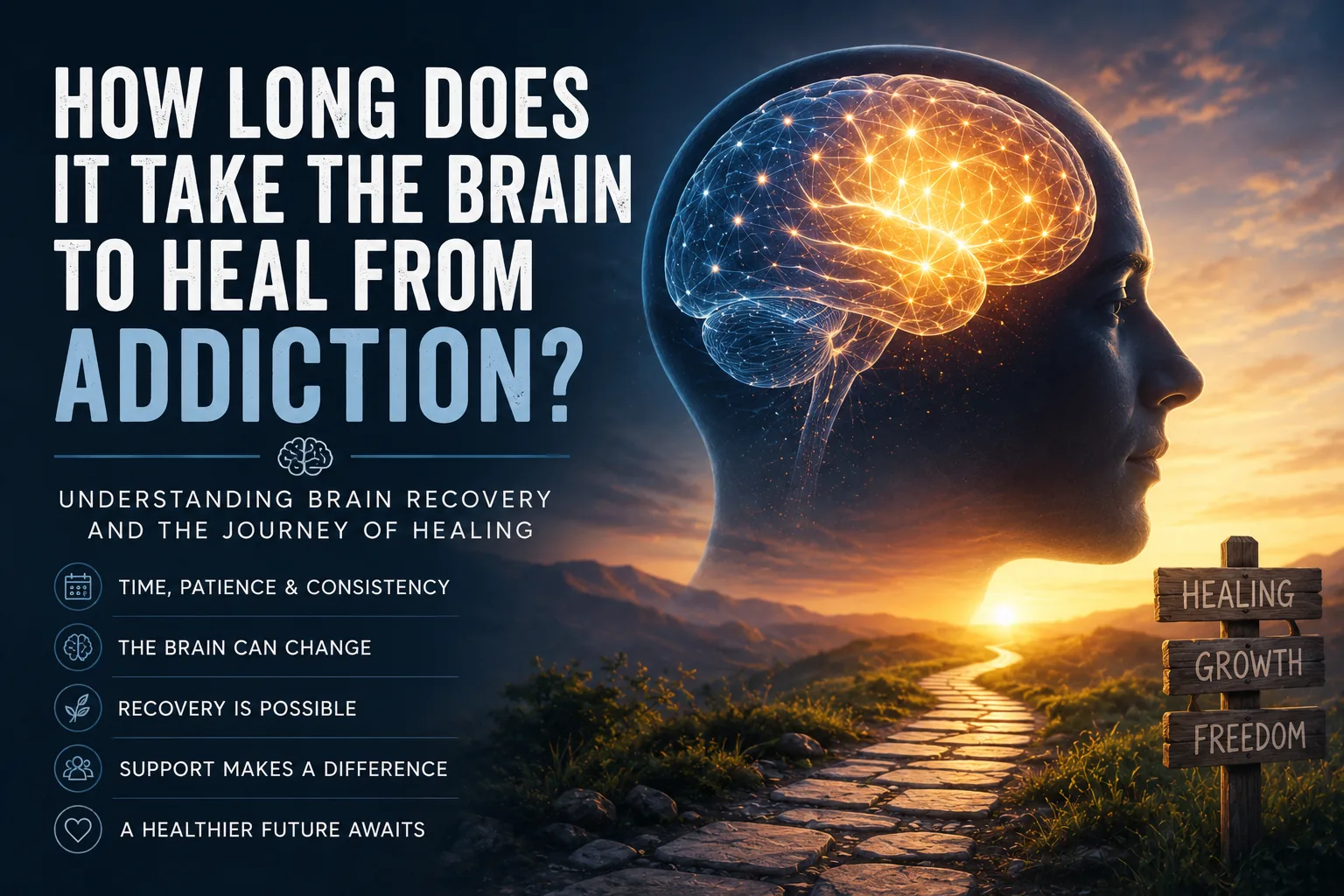


How long does it take the brain to heal from addiction? There is no single answer. Some brain functions can begin improving within weeks of stopping drugs or alcohol, while other changes may continue for months or even years. The timeline depends on the substance used, how heavily and how long it was used, a person’s age and health, mental health conditions, sleep, nutrition, treatment, and other individual factors.
The encouraging part is that the brain can change.
The same ability of the brain to adapt during repeated substance use also plays an important role in recovery. Scientists call this ability neuroplasticity. Research suggests that at least some addiction-related changes in the brain can improve during prolonged abstinence.
Understanding the addicted brain and how it can change during recovery helps explain why healing is possible but rarely immediate. Addiction can strengthen powerful connections between substances, reward, stress, memories, habits, and relief. Recovery gives the brain repeated opportunities to create healthier patterns.
But brain recovery is not like healing a broken bone on a predictable schedule.
There is no day when someone wakes up and suddenly has a completely “healed” brain.
Recovery happens gradually.
How Addiction Changes the Brain
Drugs and alcohol can interfere with the systems that normally help us survive, experience pleasure, manage stress, learn from experience, and make decisions.
Repeated substance use can affect areas involved in:
- Reward and pleasure
- Motivation
- Memory
- Learning
- Judgment
- Decision-making
- Impulse control
- Stress
- Emotional regulation
- Sleep
The brain’s reward system is especially important.
Normally, enjoyable activities such as eating, exercising, spending time with family, accomplishing a goal, or listening to music can create feelings of satisfaction.
Addictive substances can produce much stronger or faster chemical signals.
With repeated exposure, the brain adapts.
Ordinary activities may begin feeling less rewarding. A person may become increasingly focused on obtaining or using the substance even when doing so is damaging relationships, health, work, or finances.
This is part of how addiction changes the brain and what happens in recovery. Brain circuits involved in reward, learning, stress, and self-control can become increasingly connected to substance use. That helps explain why addiction can continue even when a person desperately wants to stop.
When the substance is removed, the brain has to adjust again.
That adjustment is part of recovery.
The First Days and Weeks: The Brain Begins Readjusting
During the first days without drugs or alcohol, the biggest concern may be withdrawal rather than long-term brain healing.
The nervous system is suddenly functioning without a substance it may have adapted to.
This can produce anxiety, irritability, poor concentration, sleep problems, cravings, depression, restlessness, or other symptoms.
Some withdrawal syndromes—particularly alcohol and benzodiazepine withdrawal—can become medically dangerous and may require supervised detox.
After the immediate withdrawal period, people often expect to feel dramatically better.
Sometimes they do.
But others experience brain fog, low motivation, emotional instability, sleep problems, memory difficulties, or an inability to enjoy ordinary activities.
These symptoms can be frightening because someone may believe they have permanently damaged their brain.
That is not necessarily the case.
For example, brain fog after quitting drugs or alcohol may be influenced by withdrawal, disrupted sleep, stress, depression, anxiety, exhaustion, nutrition, and the brain’s ongoing adjustment to sobriety.
Likewise, memory problems during addiction recovery can occur while attention, sleep, stress responses, and other cognitive functions are still stabilizing.
This does not necessarily mean recovery is going badly.
The brain may still be adjusting.
One to Three Months: Clearer Thinking May Begin
During the first few months, some people begin noticing significant changes.
Thinking may become clearer.
Concentration may improve.
Sleep may begin settling.
Cravings may become less constant.
Emotions can also become easier to recognize.
This does not happen at exactly 30, 60, or 90 days.
Our guides to 60 days sober, 90 days sober, and 100 days sober explore what people may notice during these stages.
Motivation can still be a major challenge. Understanding why motivation is low in early recovery is important because knowing what you should do and actually feeling motivated to do it are not always the same thing.
Your brain may still be learning how to pursue normal rewards rather than the immediate effects of drugs or alcohol.
One important thing can happen during this period:
You start practicing being sober.
Every time you experience stress without using, you practice a new response.
Every time you deal with a craving and allow it to pass, you practice another response.
Every sober argument, celebration, difficult workday, and boring evening gives the brain another opportunity to learn that drugs or alcohol are no longer the automatic answer.
That behavioral healing matters just as much as what might appear on a brain scan.
Dopamine and the Return of Normal Pleasure
A major part of brain recovery involves the reward and motivation systems commonly associated with dopamine.
Dopamine is often described simply as a “pleasure chemical,” but it also plays important roles in motivation, reinforcement, learning, and deciding which experiences are worth repeating.
Addictive drugs can strongly affect these systems.
When substance use stops, normal activities may initially feel weak by comparison.
Someone may think:
“Why doesn’t anything feel good anymore?”
That experience is common enough that we created a separate guide explaining why nothing feels good after getting sober.
For some people, the reduced ability to experience pleasure can become significant enough to be described as anhedonia. Understanding anhedonia in addiction recovery and why pleasure feels different can help people recognize that emotional flatness does not necessarily predict what long-term sober life will feel like.
The process is sometimes loosely described as “dopamine recovery,” although brain chemistry is much more complicated than one neurotransmitter. Our guide to dopamine recovery after addiction and how long it may take explores that process in greater detail.
Over time, healthy rewards may begin to matter again.
Food.
Exercise.
Relationships.
Music.
Sex.
Work.
Hobbies.
Accomplishments.
A peaceful morning.
The return of these normal rewards can be an important sign that recovery is becoming more established.
Six Months to One Year: Recovery Can Become More Established
Around six months to one year, many people feel very different from the person who entered recovery.
Healthy routines may become easier.
Sleep may become more predictable.
Concentration may improve.
Emotional reactions may feel less extreme.
Activities that once seemed boring may become enjoyable again.
This can be an important shift in the brain’s reward system.
Instead of looking almost entirely toward drugs or alcohol for relief or pleasure, the brain has had months of exposure to normal rewards:
Exercise.
Relationships.
Food.
Music.
Work.
Achievement.
Nature.
Hobbies.
Connection.
For people recovering from alcohol addiction, research suggests that some alcohol-related brain changes can improve significantly with months of abstinence. Other impairments may take much longer to improve.
This is why one year sober can feel so different from day one.
The brain has not simply been away from substances for a year.
It has spent a year practicing another way of living.
Some Brain Changes Can Take Years
Not every substance affects the brain in exactly the same way.
And not every brain recovers on the same schedule.
Research involving substances such as methamphetamine has shown that some improvements may become more noticeable after prolonged abstinence rather than only a few weeks or months.
This does not mean everyone follows the same timeline.
Age, genetics, nutrition, sleep, medical problems, mental health conditions, repeated overdoses, head injuries, and the substances involved can all influence what recovery looks like.
Someone may feel dramatically different after three months.
Another person may notice major improvements after one year.
For someone else, certain symptoms may continue much longer.
That is why exact promises such as “your brain will be normal after 90 days” can be misleading.
The question of whether the brain can fully heal after drug addiction is also more complicated than a simple yes or no. Significant healing can occur, but complete recovery depends on the person and the type of neurological effects involved.
Brain Healing Is Different From Permanent Brain Injury
There is an important difference between an addicted brain that is still recovering and permanent neurological damage.
Brain fog does not automatically mean permanent damage.
Neither does temporary forgetfulness, low motivation, poor sleep, or emotional instability.
However, addiction can sometimes contribute to serious neurological injuries.
Overdose can deprive the brain of oxygen.
Certain drugs can increase the risk of stroke.
Falls, crashes, and other substance-related accidents can cause traumatic brain injury.
Long-term heavy alcohol use can contribute to severe nutritional deficiencies that affect the brain.
Our guide examining whether addiction can cause permanent brain damage explains these risks in greater detail.
Persistent severe memory loss, confusion, seizures, speech problems, weakness, major personality changes, or other significant neurological symptoms should be evaluated by a healthcare professional.
Recovery should include knowing when the brain needs time and when symptoms need medical attention.
Why You May Still Feel Bad Even When Your Brain Is Healing
One frustrating part of recovery is that improvement does not always feel like improvement every day.
You might sleep well for a week and then suddenly experience insomnia.
Motivation may return and then disappear.
You may feel emotionally stable for several days before anxiety returns.
Cravings may vanish for weeks and then appear unexpectedly.
Recovery can be uneven.
Do not judge your entire recovery by one difficult week.
Look at the direction you are moving.
Compare where you are today with where you were 30, 60, or 90 days ago.
Progress is often easier to see over months than over days.
What Helps the Brain Heal From Addiction?
There is no supplement, detox drink, or shortcut that instantly repairs the brain.
What helps is much less exciting—and far more useful.
Time without harmful substance use.
Sleep.
Regular nutrition.
Exercise.
Mental health treatment.
Addiction treatment.
Healthy relationships.
Medication when medically appropriate.
Learning coping skills.
Reducing chronic stress.
Building a structured life.
Sleep deserves special attention because it supports memory, concentration, emotional regulation, learning, and decision-making. Addiction and withdrawal can seriously disturb normal sleep patterns, which is why understanding how sleep helps the brain heal from addiction can be an important part of recovery.
Movement matters too. Research continues to explore how physical activity affects mood, stress, sleep, cognition, and substance use outcomes. Even simple activities such as walking can become part of a healthier routine. Learn more about how exercise can help the brain recover from addiction.
Treatment matters because brain recovery is only one part of addiction recovery.
Someone also has to learn how to respond differently to stress, cravings, relationships, boredom, grief, and triggers.
A strong recovery support system and consistent daily routine can help create an environment where those healthier patterns have time to develop.
Can the Brain Fully Recover From Addiction?
Sometimes people ask whether their brain will ever be exactly the way it was before addiction.
There is no guarantee that every addiction-related change will completely disappear.
Some changes can improve substantially during prolonged recovery. Others may persist, particularly after severe or long-lasting substance use.
But there is an important distinction:
A person does not need a “perfect” brain to build an extraordinary life in recovery.
People recover.
They think clearly again.
They work.
They build businesses.
They become parents.
They repair relationships.
They return to school.
They help other people.
They enjoy life again.
Recovery is bigger than a brain scan.
It is about creating a healthier life and learning how to live without allowing addiction to control your decisions.
Brain Healing Is a Timeline, Not a Deadline
So, how long does the brain take to heal from addiction?
Some changes may begin within days or weeks.
More noticeable improvements may develop over several months.
Other changes may continue for one year, two years, or longer.
There is no universal deadline.
That is why comparing your 60 days of recovery with somebody else’s six months usually does not help.
Your brain has its own history.
Your recovery has its own timeline.
What matters is continuing to create the conditions where healing can happen.
Stay connected to treatment.
Protect your sleep.
Take care of your body.
Build a strong support system.
Watch for relapse warning signs.
And give yourself time.
The brain spent months or years adapting to substance use.
Recovery gives it the opportunity to adapt again.
Healing does not happen all at once. But every day in recovery gives the brain another day to change.


