



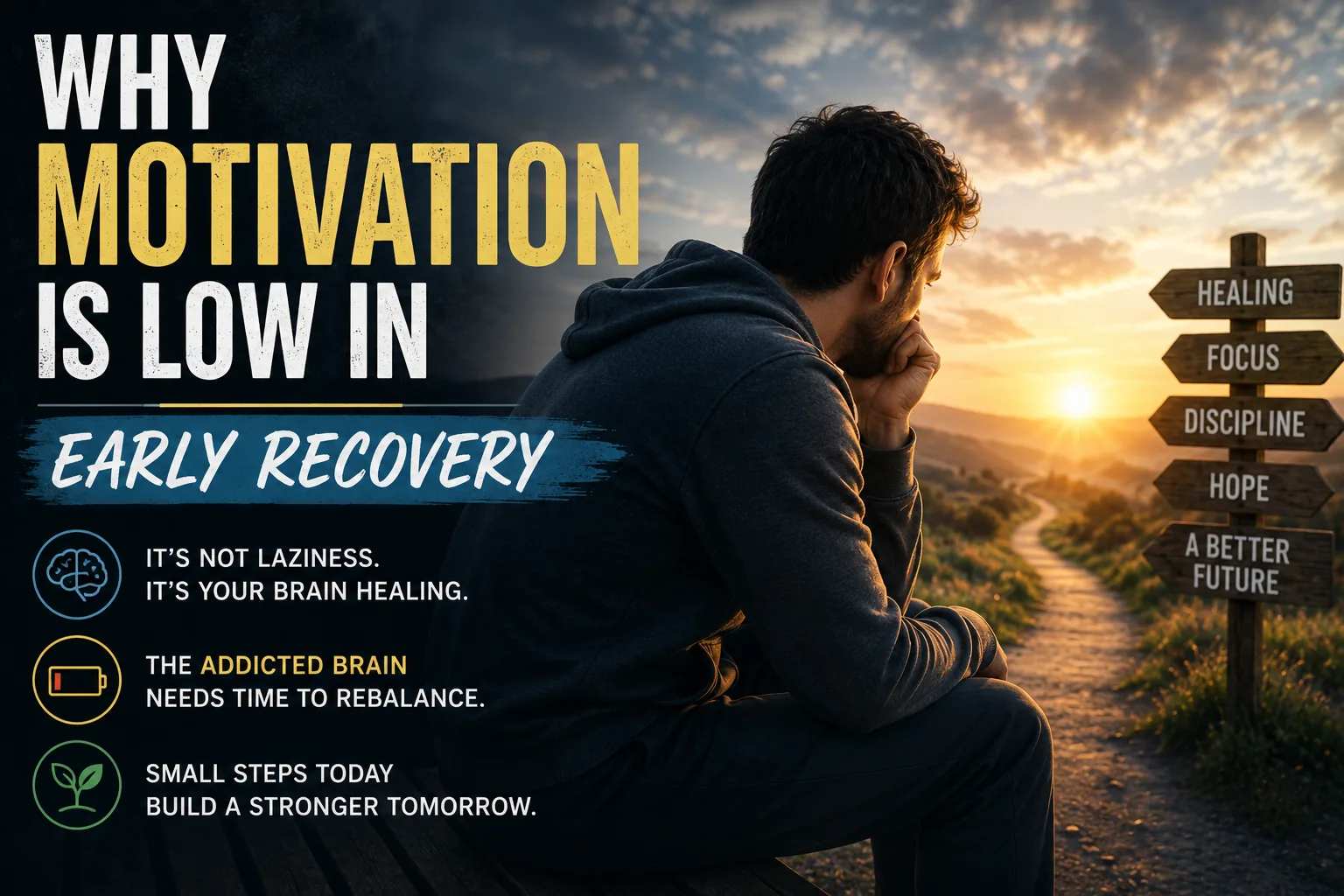


Low motivation is one of the most common and frustrating parts of recovery. You may know what you should do, but still struggle to get out of bed, exercise, make appointments, go to meetings, answer messages, or even care about goals that once mattered.
This can be especially confusing when you expected sobriety to make everything better right away.
For someone with an addicted brain, motivation may take time to return. Drugs and alcohol can change the brain systems involved in reward, effort, pleasure, stress, and decision-making. When substance use stops, those systems do not instantly return to normal.
Understanding The Brain in Addiction Recovery can help explain why early sobriety sometimes feels flat, exhausting, and strangely empty.
It can also help to understand how addiction changes the brain and what happens during recovery. Motivation is not controlled by willpower alone. Reward, dopamine, sleep, stress, memory, emotions, and learned behaviors can all influence whether your brain decides something feels worth doing.
It can also help protect against relapse by reminding you that low motivation does not mean recovery is failing.
Why Motivation Can Disappear After Addiction
Motivation is closely connected to the brain’s reward system.
Normally, your brain helps motivate you to do things that are useful or enjoyable.
Eat when you are hungry.
Work toward a goal.
Exercise.
Spend time with people you love.
Finish a project.
Learn something new.
These activities can produce feelings of satisfaction that encourage you to repeat them.
Addictive substances can interfere with this system.
Some drugs create powerful and rapid reward signals. Over time, the brain can begin treating the substance as something extremely important.
Ordinary rewards may start feeling weaker.
The addicted brain may learn:
“Drugs matter more than everything else.”
Then the drugs or alcohol are removed.
Suddenly, the brain has to find motivation in normal life again.
That adjustment can take time.
This is one reason nothing may feel good after getting sober. Activities that once seemed enjoyable may temporarily feel boring or emotionally flat.
For some people, this reduced ability to experience pleasure can become significant enough to be described as anhedonia in addiction recovery.
If nothing feels rewarding, finding the motivation to do anything can naturally become much harder.
The Brain in Addiction Recovery Is Still Relearning Reward
One of the most important things to understand about The Brain in Addiction Recovery is that healing involves learning.
During active addiction, the brain repeatedly connected substance use with reward, relief, escape, energy, confidence, or comfort.
Recovery requires different associations.
Stress becomes connected with calling someone instead of using.
Boredom becomes connected with exercise instead of getting high.
Celebration becomes connected with people instead of alcohol.
Pain becomes connected with treatment instead of drugs.
These new patterns do not become automatic overnight.
At first, healthy choices can feel like work.
That does not mean they are not helping.
You are practicing a different way of living.
Every time you complete a healthy action without waiting to “feel like it,” you give the brain another experience to learn from.
That repetition matters.
Dopamine and Motivation After Addiction
People often hear that low motivation after addiction is caused by “low dopamine.”
Dopamine does play an important role in motivation, reinforcement, learning, attention, and reward.
But the situation is more complicated than simply having too little dopamine.
Repeated substance use can alter the way the brain responds to rewards. When the substance disappears, normal activities may initially feel much less important.
Understanding dopamine recovery after addiction and how long it can take can help explain why motivation may gradually return rather than instantly switching back on.
The brain also uses many other chemical and neurological systems.
Sleep disruption can reduce energy.
Depression can destroy motivation.
Anxiety can make simple decisions feel exhausting.
Withdrawal can leave you physically drained.
Stress can make it difficult to focus on long-term goals.
This is why trying to “boost dopamine” with supplements or internet hacks is usually an oversimplification.
Recovery is about supporting the whole person, not chasing one brain chemical.
Why Everything Feels Like Too Much Work
Early recovery can be physically and emotionally exhausting.
Your sleep may still be poor.
Your mood may be unstable.
You may be anxious.
You may feel depressed.
You may have brain fog.
You may be dealing with cravings.
At the same time, you may be trying to repair relationships, return to work, pay bills, attend treatment, and rebuild your life.
Even simple tasks can feel overwhelming.
Someone may look at a sink full of dishes and think:
“I just can’t do this.”
That feeling may have less to do with laziness and more to do with a brain and body under stress.
Early recovery requires energy.
Sometimes there is not much energy left for motivation.
Brain fog after quitting drugs or alcohol can make ordinary tasks feel even harder because concentration, decision-making, and mental energy may all be affected.
Someone might know exactly what needs to be done but feel mentally exhausted just thinking about doing it.
Memory Problems Can Make Motivation Harder
Memory and motivation are different, but problems with one can make the other more difficult.
Imagine constantly forgetting:
Appointments.
Tasks.
Conversations.
Bills.
Instructions.
Things you promised someone you would do.
These memory problems during addiction recovery can create frustration and reduce confidence.
You may begin thinking:
“What’s the point? I can’t keep anything straight anyway.”
That can feed low motivation.
This is why simple tools can matter.
Write things down.
Use reminders.
Keep a calendar.
Make short lists.
Create routines.
Reducing the amount your brain has to remember can leave more mental energy for actually completing the task.
Low Motivation Can Become a Relapse Trigger
Low motivation may seem harmless compared with intense cravings, but it can increase relapse risk.
The thought process can begin slowly.
“I don’t feel like doing anything.”
Then:
“Sobriety is boring.”
Then:
“I felt more alive when I was using.”
The addicted brain may begin remembering the temporary benefits of substance use.
A stimulant may have made you feel energetic.
Alcohol may have made socializing easier.
Opioids may have made emotional pain disappear.
The brain may forget the consequences.
The withdrawal.
The money.
The lying.
The missed work.
The broken trust.
The fear.
That selective memory can be dangerous.
Recognizing low motivation as part of early recovery can help you respond before frustration becomes relapse thinking.
A difficult day does not mean sobriety is not working.
It may simply mean the brain is still adjusting.
Do Things Before You Feel Motivated
This may sound strange, but you do not always have to feel motivated before taking action.
Sometimes action creates motivation.
You may not feel like walking.
Walk for ten minutes anyway.
You may not feel like calling someone.
Make the call anyway.
You may not feel like cleaning.
Clean one small area.
You may not feel like attending a meeting.
Show up anyway.
Early recovery often requires doing healthy things before they feel rewarding.
Over time, the brain can begin connecting those activities with accomplishment, connection, and relief.
Small wins matter.
You do not have to completely rebuild your life today.
You only need to take the next reasonable step.
Create Structure When Motivation Is Low
A routine can protect you when motivation cannot.
Try to build simple anchors into the day.
Wake up around the same time.
Eat meals regularly.
Take medications as prescribed.
Exercise.
Attend treatment.
Go to bed at a consistent time.
Keep appointments.
Use a calendar.
Make a short daily task list.
Do not write down 25 things.
Pick three.
If you accomplish them, that is progress.
Structure reduces the number of decisions you have to make.
That matters because decision-making can feel exhausting in early recovery.
A routine also means you do not have to renegotiate every healthy behavior with yourself each day.
You simply know what comes next.
Sleep Can Have a Major Effect on Motivation
It is difficult to feel motivated when you are exhausted.
Sleep problems are common during addiction recovery, and poor sleep can affect concentration, mood, decision-making, memory, stress tolerance, and energy.
Someone who sleeps badly for several nights may interpret exhaustion as:
“I don’t care about anything.”
But sometimes the body simply needs rest.
Understanding how sleep helps the brain heal from addiction can help explain why improving sleep may support many other areas of recovery.
Try to build a consistent sleep and wake schedule.
Reduce unnecessary stimulation before bed.
Talk with a healthcare professional if insomnia continues or significantly interferes with daily functioning.
Sleep is not laziness.
It is part of brain health.
Exercise Can Help Create Momentum
Exercise may be one of the last things you want to do when motivation is low.
That is exactly why starting small can help.
Walk around the block.
Stretch for ten minutes.
Ride a bike.
Swim.
Lift weights.
Take a fitness class.
Physical activity can support mood, sleep, stress management, physical health, and daily structure.
Our guide to how exercise can help the brain recover from addiction explains why movement can become a useful part of a broader recovery plan.
The goal is not to become an athlete.
The goal is to move.
Completing a workout—even a short one—can give you evidence that you are capable of taking action despite low motivation.
Pay Attention to Depression
Low motivation can be part of recovery, but it can also be a symptom of depression.
You should not assume every emotional problem will disappear if you simply stay sober long enough.
Talk with a healthcare professional if low motivation is severe, persistent, or accompanied by:
- Hopelessness
- Constant sadness
- Severe anxiety
- Loss of interest in nearly everything
- Major sleep changes
- Inability to function
- Thoughts of harming yourself
Mental health conditions often occur alongside addiction and may require treatment of their own.
Getting help is part of recovery.
How Long Does It Take Motivation to Return?
There is no universal timeline.
Some people notice improvements within weeks.
Others need months.
Motivation may also return unevenly.
You may suddenly feel excited about work but still have no desire to socialize.
Exercise may start feeling rewarding while hobbies remain boring.
You may have a productive week followed by several difficult days.
That does not necessarily mean you are moving backward.
The broader brain healing timeline after addiction varies depending on the substance used, length and severity of use, sleep, nutrition, mental health, overall health, and other individual factors.
Recovery rarely follows a perfectly straight line.
Does Low Motivation Mean Your Brain Is Permanently Damaged?
Usually, low motivation by itself does not prove permanent brain damage.
Many addiction-related changes can improve during sustained recovery.
Questions about whether the brain can fully heal after drug addiction depend on the person’s history, substances involved, overall health, and whether additional neurological injuries occurred.
There are situations where addiction can cause permanent brain damage, particularly when substance use leads to complications such as overdose-related oxygen deprivation, stroke, traumatic brain injury, or severe nutritional deficiencies.
But feeling tired, unmotivated, emotionally flat, or mentally foggy during early sobriety does not automatically mean permanent damage has occurred.
Persistent or worsening neurological symptoms should be evaluated by a healthcare professional.
Motivation Can Return Slowly
Many people expect motivation to return like a switch.
More often, it returns in small pieces.
You make your bed.
You answer an email.
You go to the gym.
You cook dinner.
You show up to work on time.
You keep a promise.
Then one day you realize something has changed.
You are making plans again.
You care about the future.
You want things.
That matters.
The addicted brain may have spent years organizing life around drugs or alcohol.
Recovery gives the brain time to build new priorities.
You Do Not Need to Feel Inspired Every Day
Recovery is not built entirely on inspiration.
Some days you will feel hopeful.
Other days you will feel tired.
Some days you will feel strong.
Other days you may simply get through the day without using.
That still counts.
Low motivation in early recovery does not mean you are incapable of change.
It does not mean sobriety will always feel this difficult.
And it does not mean you need to wait until you feel motivated before you start rebuilding your life.
Your brain spent time learning that drugs or alcohol were important.
Recovery gives it new information.
Work can matter.
Relationships can matter.
Health can matter.
Goals can matter.
Your future can matter.
Take the next healthy step, even if it feels small. Motivation often follows action, and every sober action gives your brain another chance to learn a better way forward.


