



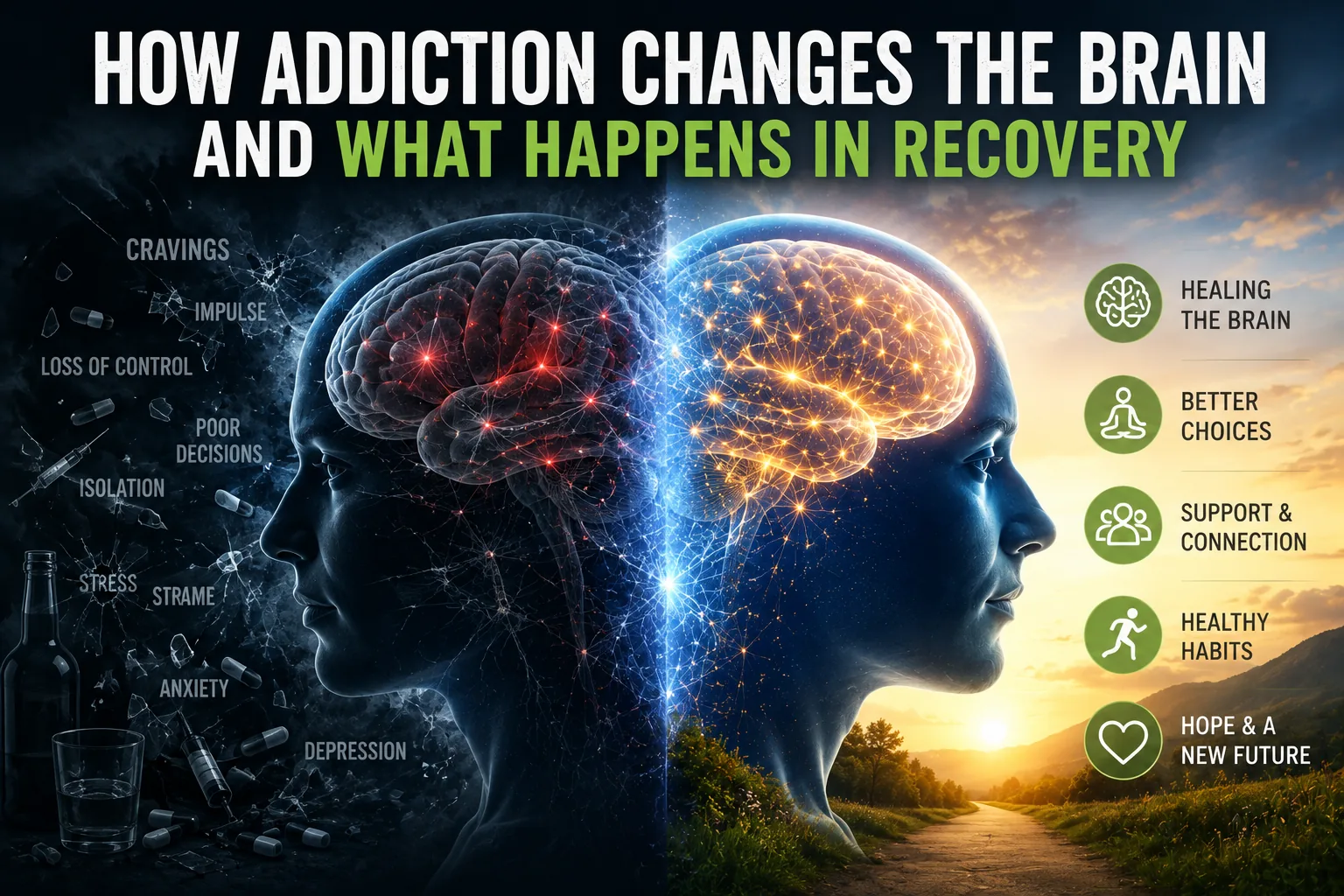


Addiction changes the brain in ways that can make stopping drugs or alcohol far more difficult than simply deciding to quit. Repeated substance use can affect the brain systems involved in reward, motivation, stress, memory, judgment, and self-control. Over time, a person may continue drinking or using drugs even when they clearly understand the damage being caused.
Understanding the addicted brain and how it changes during recovery can help explain why addiction is not simply a matter of weak willpower—and why recovery requires more than just removing the substance.
That does not mean the brain is permanently ruined.
The brain can adapt again.
During addiction recovery, many of the systems affected by drugs or alcohol begin adjusting to life without repeated substance exposure. Cravings may become less powerful. Thinking can become clearer. Healthy activities may feel rewarding again.
Recovery takes time, but the brain is capable of change. The exact brain healing timeline after addiction varies from person to person and can continue for months or even years.
How Addiction Affects the Brain’s Reward System
Your brain has a natural reward system designed to encourage behaviors that help you survive.
Eating.
Connecting with other people.
Exercising.
Reaching a goal.
Having sex.
These experiences can activate chemical signals involving dopamine and other neurotransmitters that tell the brain:
“That was important. Do it again.”
Drugs and alcohol can interfere with this system.
Some substances create unusually strong reward signals. With repeated use, the brain begins adapting to those signals.
Eventually, ordinary activities may not feel as rewarding.
Dinner with family may seem boring.
Exercise may feel pointless.
Work accomplishments may provide little satisfaction.
Meanwhile, the brain increasingly associates the drug or alcohol with pleasure, relief, or survival.
This helps explain why dopamine recovery after addiction can take time. Dopamine is involved not only in pleasure but also in motivation, learning, reinforcement, and the drive to repeat behaviors the brain considers important.
That can help explain why someone continues using despite losing relationships, money, health, employment, or other things they deeply value.
The brain has learned that the substance is extremely important.
Recovery involves teaching it something different.
Tolerance Changes What the Brain Needs
Repeated substance use can also lead to tolerance.
Someone may need larger amounts of a drug or alcohol to experience the effect they once got from a smaller amount.
This happens because the brain and body adapt.
At the same time, the person may feel increasingly uncomfortable when the substance is not present.
They may experience:
- Anxiety
- Irritability
- Restlessness
- Depression
- Sleep problems
- Physical discomfort
- Strong cravings
At this point, substance use may no longer be primarily about getting high.
It may become about avoiding feeling terrible.
That cycle can make addiction extremely difficult to break without treatment and support.
Addiction Can Affect Judgment and Self-Control
The reward system is not the only part of the brain involved in addiction.
Repeated substance use can also affect areas involved in:
- Decision-making
- Planning
- Impulse control
- Attention
- Memory
- Emotional regulation
This creates a difficult situation.
Part of the person’s brain may understand:
“Using again could cost me my marriage.”
Another part is screaming:
“Use now.”
That conflict is one reason telling someone with addiction to simply “make better choices” often misses what is actually happening.
Choice still matters.
But addiction can change the brain systems responsible for making and carrying out those choices.
Cognitive changes may also continue after substance use stops. Some people experience memory problems during addiction recovery, including difficulty remembering conversations, appointments, instructions, or new information.
Treatment helps people strengthen healthier behaviors while reducing exposure to the triggers that reinforce substance use.
Stress Can Become Connected to Substance Use
Addiction can also change how someone responds to stress.
Maybe alcohol became the answer after a difficult workday.
Opioids became the answer to emotional pain.
Cocaine became the answer to exhaustion.
Drugs became the answer to loneliness.
Over time, the brain can build powerful associations between uncomfortable emotions and substance use.
Stress happens.
The brain remembers:
“This is when we use.”
That response can remain even after someone gets sober.
This is why stress, relationship conflict, grief, loneliness, and lack of sleep can become important relapse triggers.
Recovery involves developing another response.
Call someone.
Exercise.
Attend a meeting.
Talk with a counselor.
Go for a walk.
Leave the situation.
Sleep.
Ask for help.
Every time someone responds differently, they practice a new pathway.
What Happens to the Brain When You Get Sober?
When substance use stops, the brain does not instantly return to its previous state.
It has to adjust again.
During the first days of sobriety, withdrawal may be the biggest concern.
Symptoms depend on the substance and can include anxiety, nausea, sweating, shaking, irritability, insomnia, depression, fatigue, or intense cravings.
Alcohol and benzodiazepine withdrawal can become medically dangerous and may require supervised detox.
After withdrawal improves, someone may still experience:
- Brain fog
- Low motivation
- Poor concentration
- Sleep problems
- Mood swings
- Anxiety
- Difficulty enjoying normal activities
- Cravings
These symptoms can be frustrating.
Brain fog after quitting drugs or alcohol can make thinking feel slow, concentration difficult, and everyday tasks mentally exhausting.
Low motivation can be just as confusing. Understanding why motivation is low in early recovery can help explain why knowing what you should do does not always mean you immediately feel driven to do it.
Someone may think:
“I’ve been sober for a month. Why don’t I feel normal yet?”
Because recovery takes time.
The brain spent months or years adapting to substance use. It may need months or longer to build a new normal.
The Brain Can Heal During Recovery
The brain has an important ability called neuroplasticity.
That means it can change and reorganize in response to experiences and behaviors.
Recovery takes advantage of this ability.
Every sober day provides new experiences.
You deal with stress without using.
You sleep without passing out from alcohol.
You celebrate without drugs.
You experience boredom without immediately escaping it.
You exercise.
You work.
You repair relationships.
You build a daily recovery routine.
Those experiences begin teaching the brain something new:
Life can happen without substances.
Some people notice clearer thinking within weeks or months.
Others need much longer.
Questions about whether the brain can fully heal after drug addiction do not have a simple yes-or-no answer. Significant healing is possible, but the degree and timeline depend on the type and severity of substance use and whether other neurological injuries occurred.
There is no exact deadline for brain healing.
Normal Life Can Become Rewarding Again
One of the most encouraging changes in recovery is that ordinary activities can begin feeling good again.
Maybe you enjoy food more.
Music feels different.
Exercise becomes satisfying.
You enjoy being around your children.
You become proud of your work.
You look forward to travel.
You develop hobbies.
These experiences may sound ordinary.
That is exactly the point.
During addiction, powerful chemical rewards can overshadow normal life.
Recovery gives the brain time to rediscover it.
For some people, however, nothing feels good after getting sober for a period of time. This emotional flatness can be alarming when someone expected sobriety to immediately make life feel better.
A more significant inability to experience pleasure may be described as anhedonia during addiction recovery. Recognizing this experience matters because boredom and emotional numbness can become relapse risks if a person starts believing drugs or alcohol are the only way to feel good again.
This can be one of the biggest differences between early recovery and long-term recovery.
At first, sobriety may feel like constantly saying no to drugs or alcohol.
Later, recovery becomes filled with things you can say yes to.
Sleep and Exercise Can Support Brain Recovery
Brain recovery does not depend on one treatment, supplement, or trick.
Basic health habits matter.
Sleep is particularly important because it supports concentration, memory, emotional regulation, learning, and decision-making. Unfortunately, addiction and withdrawal can severely disrupt normal sleep patterns.
Understanding how sleep helps the brain heal from addiction can help explain why protecting sleep is an important part of rebuilding cognitive and emotional health.
Exercise may help support recovery as well.
Physical activity can provide structure, improve sleep, reduce stress, support mood, and give the brain access to healthy forms of reward. Even walking can become valuable. Learn more about how exercise can help the brain recover from addiction.
Neither sleep nor exercise cures addiction.
But both can help create healthier conditions for recovery.
Why Cravings Can Return After Months or Years
Brain healing does not mean every memory connected with substance use disappears.
The brain is extremely good at remembering powerful experiences.
A certain neighborhood.
A smell.
A person.
A song.
A stressful event.
Even years later, one of those cues may suddenly trigger a craving.
That does not mean recovery has failed.
It means the brain remembers.
This is why a relapse prevention plan can remain useful even during long-term sobriety.
People with years of recovery often become very good at recognizing these signals quickly.
A craving appears.
They know what it is.
They know it will pass.
And they know what to do next.
Can Addiction Cause Permanent Brain Damage?
Most brain changes associated with addiction should not automatically be described as permanent damage.
Many functions can improve during sustained recovery.
However, some substance-related complications can cause lasting neurological injury.
Overdose may deprive the brain of oxygen.
Certain substances can increase the risk of stroke.
Falls, accidents, and violence can cause traumatic brain injuries.
Long-term heavy alcohol use may contribute to severe nutritional deficiencies that affect the nervous system.
Our guide to whether addiction can cause permanent brain damage explains the difference between a brain that is still recovering and neurological injuries that may require long-term medical care.
Persistent severe memory loss, confusion, seizures, weakness, speech problems, major personality changes, or other significant neurological symptoms should be evaluated by a healthcare professional.
Recovery Changes More Than the Brain
The brain is important, but successful recovery involves much more.
People also rebuild:
Relationships.
Health.
Housing.
Finances.
Careers.
Trust.
Daily routines.
Confidence.
Purpose.
These things become part of a person’s recovery capital—the resources that make long-term recovery stronger.
The stronger that foundation becomes, the less recovery depends on willpower alone.
Addiction Changes the Brain, but Recovery Changes It Too
Addiction is not simply bad behavior or weak character.
Repeated substance use can change how the brain experiences reward, stress, motivation, memory, and decision-making.
That helps explain why stopping can be so difficult.
But it also explains something hopeful.
The brain can continue changing after substance use stops.
Recovery provides time.
Treatment provides tools.
Healthy routines provide stability.
Relationships provide support.
Sleep gives the brain time to recover.
Exercise provides healthy stimulation and structure.
And repeated sober experiences teach the brain another way to live.
At first, recovery may feel like fighting against everything your brain has learned.
Over time, something changes.
The healthier response becomes familiar.
Then natural.
And eventually, the life that once seemed impossible can begin feeling normal.
Addiction changes the brain. Recovery gives the brain the opportunity to change again.


