



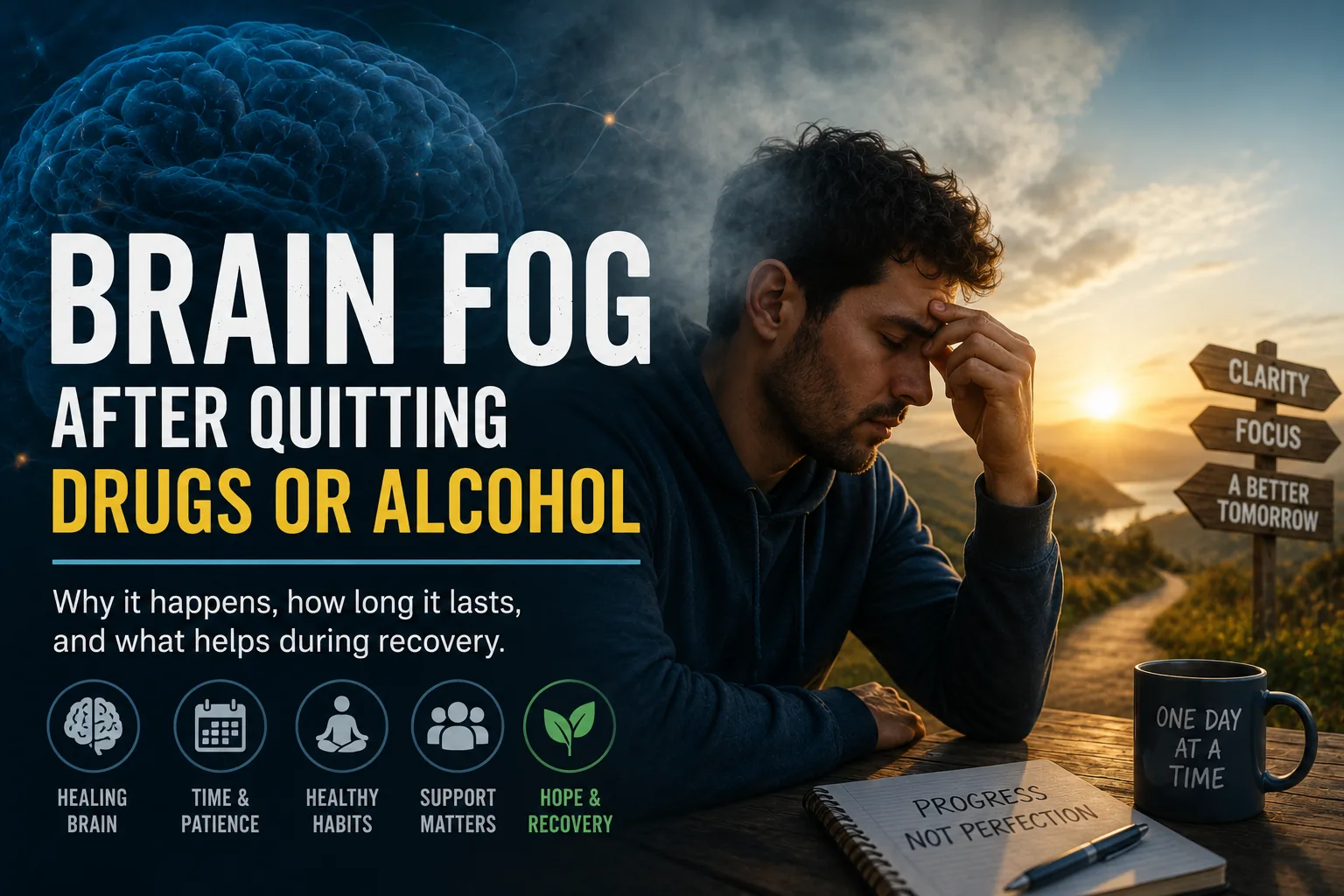


Brain fog after quitting drugs or alcohol can be one of the most frustrating parts of recovery. You may be sober, but your thinking feels slow. You forget why you walked into a room. You struggle to focus on a conversation. Reading may take more effort. Work feels harder. Even simple decisions can leave you mentally exhausted.
For someone with an addicted brain, this can be frightening.
You may wonder:
“Did I permanently damage my brain?”
In many cases, brain fog improves with time. The brain and body are adjusting after repeated substance use, and that adjustment can take weeks or months. Understanding The Brain in Addiction Recovery can help you recognize that feeling mentally slow does not automatically mean something is permanently wrong.
Learning more about how addiction changes the brain and what happens during recovery can also explain why attention, memory, motivation, reward, and decision-making may take time to stabilize after substance use ends.
It may mean your brain is still healing.
What Does Brain Fog Feel Like After Getting Sober?
Brain fog is not a specific medical diagnosis. It is a common way people describe problems involving thinking, memory, attention, and mental energy.
You might experience:
- Trouble concentrating
- Forgetfulness
- Slow thinking
- Difficulty finding words
- Poor short-term memory
- Mental exhaustion
- Trouble making decisions
- Feeling disconnected or “out of it”
- Difficulty following conversations
- Problems staying organized
You may know that you are capable of thinking more clearly, but your brain simply does not seem to cooperate.
This can be especially frustrating if you expected sobriety to immediately make you sharper.
Recovery often does improve thinking.
It just may not happen overnight.
People experiencing significant forgetfulness may also benefit from understanding memory problems during addiction recovery, since problems with attention, sleep, stress, and memory often overlap during early sobriety.
Why Does Brain Fog Happen After Quitting Drugs or Alcohol?
Long-term substance use can affect several systems involved in memory, attention, sleep, mood, stress, and decision-making.
Different substances affect the brain differently.
Alcohol can interfere with memory, sleep, judgment, and other cognitive functions.
Stimulants such as methamphetamine and cocaine can affect attention, motivation, reward, sleep, and emotional regulation.
Opioids can affect concentration, alertness, stress responses, and reward systems.
Sedatives can interfere with memory and cognitive processing.
When substance use stops, the brain suddenly has to function without the chemical environment it became used to.
That transition can feel uncomfortable.
The addicted brain has adapted to repeated exposure to drugs or alcohol. Recovery requires another period of adaptation.
Changes in the brain’s reward and motivation systems may also contribute. The process sometimes described as dopamine recovery after addiction can occur alongside changes in attention, motivation, mood, and the ability to experience normal rewards.
During that time, thinking may feel slower than usual.
Withdrawal Can Make Brain Fog Worse
Early withdrawal can cause significant mental and physical stress.
Someone may be dealing with:
- Poor sleep
- Anxiety
- Depression
- Irritability
- Fatigue
- Cravings
- Dehydration
- Nutritional problems
- Physical discomfort
All of these can make concentration more difficult.
Think about how hard it is to focus after one bad night of sleep.
Now imagine several nights of disrupted sleep combined with anxiety, withdrawal, cravings, and physical exhaustion.
It makes sense that your brain might not feel sharp.
For some people, these problems improve quickly after withdrawal passes.
For others, cognitive symptoms continue longer.
Emotional changes may occur at the same time. Some people find that nothing feels good after getting sober, which can make brain fog feel even more discouraging because both thinking and enjoyment seem impaired at once.
The Brain in Addiction Recovery Needs Time
Understanding The Brain in Addiction Recovery means understanding that healing is not instant.
The brain is constantly adapting.
During addiction, it adapted to repeated substance use.
During recovery, it begins adapting to sobriety.
Some people notice clearer thinking within a few weeks.
Others may continue experiencing brain fog for several months.
The timeline depends on many factors, including:
- Substance used
- Length of substance use
- Amount used
- Age
- Sleep quality
- Nutrition
- Mental health
- Physical health
- Medications
- History of overdose
- Multiple substance use
There is no exact date when everyone suddenly wakes up feeling completely clear.
Recovery is gradual.
Our guide to how long the brain takes to heal from addiction looks more closely at why some improvements may happen within weeks while other neurological and behavioral changes continue for months or years.
People also commonly wonder whether the brain can fully heal after drug addiction. Significant improvement is possible, but recovery varies according to the substance involved, duration and severity of use, overall health, and whether additional brain injuries occurred.
Poor Sleep Can Keep Your Brain Feeling Foggy
Sleep is one of the biggest factors affecting cognitive function.
Unfortunately, sleep problems are common in early recovery.
Someone may have difficulty falling asleep.
Others wake repeatedly.
Some experience vivid dreams.
Others sleep for long periods but still feel exhausted.
Poor sleep can affect:
Memory.
Attention.
Mood.
Reaction time.
Decision-making.
Emotional control.
If your sleep is still unstable, part of your brain fog may be related to exhaustion rather than permanent brain damage.
A consistent sleep schedule can become an important part of recovery.
Understanding how sleep helps the brain heal from addiction can help explain why protecting sleep is about much more than simply feeling rested. Sleep supports learning, memory, concentration, emotional regulation, and the brain’s ability to function effectively the following day.
Anxiety and Depression Can Also Feel Like Brain Fog
Not every concentration problem comes directly from substance use.
Depression can make thinking feel painfully slow.
Anxiety can make it difficult to concentrate because the brain is constantly focused on worry.
PTSD can affect memory, attention, sleep, and emotional regulation.
ADHD may become more noticeable once drugs or alcohol are removed.
This is why persistent brain fog should not automatically be blamed on addiction.
Mental health conditions can occur alongside substance use disorders and may need treatment of their own.
Low motivation may also be mistaken for cognitive impairment. Someone may be capable of completing a task but feel almost no drive to begin it. Understanding why motivation is low in early recovery can help separate problems involving motivation from problems involving memory or concentration.
Brain Fog, Anhedonia and Emotional Numbness Can Overlap
Cognitive recovery does not happen separately from emotional recovery.
Someone may have brain fog while also struggling with low motivation, emotional numbness, anxiety, or difficulty enjoying life.
A reduced ability to experience pleasure is known as anhedonia. Learning about anhedonia in addiction recovery and why pleasure feels different can help explain why normal activities may initially seem less satisfying.
Imagine being unable to concentrate while also feeling that nothing is rewarding.
Work becomes harder.
Socializing feels pointless.
Exercise sounds exhausting.
Hobbies seem boring.
That combination can make early recovery feel far worse than someone expected.
But several recovery symptoms occurring together does not necessarily mean they will all remain permanently.
Different parts of recovery can improve on different timelines.
Brain Fog Can Become a Relapse Trigger
Brain fog may seem less dangerous than cravings, but it can contribute to relapse.
Imagine being sober for several weeks and still feeling mentally exhausted.
You cannot focus.
You are struggling at work.
You feel frustrated.
Then the thought appears:
“I used to function better when I was using.”
That thought can become dangerous.
The addicted brain may remember moments when substances seemed to increase energy, confidence, or concentration while ignoring the long-term consequences.
A stimulant may have made you feel productive temporarily.
Alcohol may have made anxiety disappear temporarily.
Opioids may have made emotional pain feel distant temporarily.
But temporary relief came with a cost.
Recognizing brain fog as part of recovery can help prevent frustration from turning into relapse thinking.
It can also help to remember that using again does not repair the brain. It exposes the brain and body to substance-related risks again and can interrupt the healthier patterns you are beginning to build.
What Helps Brain Fog During Recovery?
There is no instant cure, but simple habits can make a major difference.
Protect your sleep. Try to sleep and wake at similar times each day.
Eat regularly. Your brain needs energy and nutrients to function.
Drink enough water. Dehydration can contribute to fatigue and concentration problems.
Exercise. Physical activity can support mood, sleep, circulation, and overall brain health. Our guide to how exercise can help the brain recover from addiction explains why regular movement can be a useful part of a broader recovery plan.
Slow down. You may need lists, reminders, calendars, and notes while your concentration improves.
Reduce unnecessary stress. Your brain already has plenty of adjustment happening.
Stay connected to treatment. Medical and behavioral health care can identify problems that need more than time alone.
Avoid chasing quick fixes. Supplements and online “brain reset” programs often promise more than they can deliver.
Recovery is usually built through consistent habits, not miracle solutions.
When Should You Talk to a Doctor?
Brain fog is common, but severe or persistent symptoms should be evaluated.
Seek professional help if you experience major memory problems, confusion, severe depression, trouble functioning at work or home, personality changes, weakness, seizures, or other neurological symptoms.
A history of overdose, head injury, heavy alcohol use, or serious nutritional problems can also make medical evaluation especially important.
Not every cognitive symptom should simply be accepted as part of getting sober.
There is also an important difference between temporary brain fog and lasting neurological injury. Our guide to whether addiction can cause permanent brain damage explains how complications such as oxygen deprivation during overdose, stroke, traumatic brain injury, and severe nutritional deficiencies can sometimes cause more serious problems.
Clear Thinking Can Return
Early recovery can make you question everything.
You may feel like your brain is slower than it used to be.
You may lose your train of thought.
You may struggle to remember simple things.
But that does not necessarily mean this is your new normal.
The addicted brain spent time adapting to substance use.
It needs time to adapt to life without it.
Week by week, sleep may improve.
Concentration may return.
Memory may sharpen.
Decisions may become easier.
Motivation may begin coming back.
Ordinary activities may become enjoyable again.
You may suddenly realize that you just made it through an entire day without feeling mentally foggy.
That progress can be easy to miss because it often happens gradually.
Brain fog after quitting drugs or alcohol can be frustrating, but recovery gives your brain something it may not have had in a long time: the opportunity to heal, adapt, and become clearer again.


