



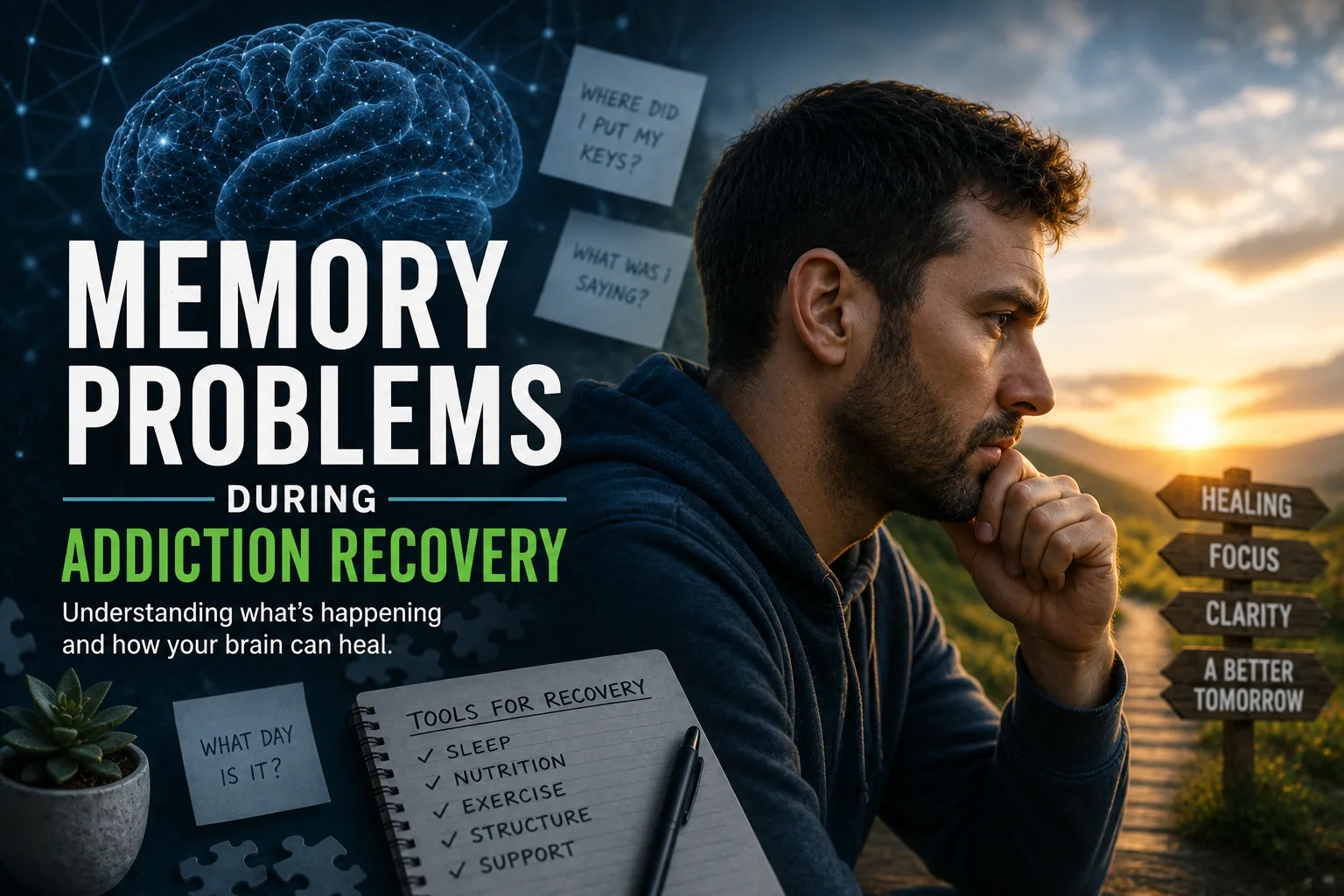


Memory problems during addiction recovery can be unsettling. You may forget conversations, lose track of appointments, struggle to remember names, or walk into a room and forget why you are there. For someone in recovery, these moments can create real fear about whether drugs or alcohol caused permanent damage.
They can also become dangerous emotionally.
When the addicted brain feels slow or unreliable, frustration can build. You may start thinking that you functioned better while using. That thought can increase the risk of relapse, especially if you are already dealing with cravings, poor sleep, anxiety, or depression.
The good news is that memory problems can improve as the brain and body adjust to life without substances. Understanding The Brain in Addiction Recovery can help explain why memory may feel worse before it gets better.
Learning more about how addiction changes the brain and what happens during recovery can also help put these symptoms into perspective. Addiction can affect much more than reward. Attention, learning, sleep, stress, decision-making, and memory can all be involved.
Why Addiction Can Affect Memory
Memory is not controlled by one single part of the brain.
Remembering something requires several processes.
You have to pay attention.
Your brain has to store the information.
Then it has to retrieve it later.
Substance use can interfere with any of these steps.
Alcohol can affect short-term memory and the brain’s ability to form new memories. Heavy drinking can even cause blackouts, where someone remains awake but later cannot remember what happened.
Stimulants can disrupt sleep and attention, which makes memory more difficult.
Sedatives can interfere with concentration and memory formation.
Opioids may affect attention, alertness, sleep, and cognitive processing.
When substances are used repeatedly, memory problems can become more noticeable.
But stopping the substance does not always make memory immediately return to normal.
That is because the brain may need time to adjust. Our guide to how long the brain takes to heal from addiction explains why different brain functions can improve on different timelines.
The Brain in Addiction Recovery Needs Time
Understanding The Brain in Addiction Recovery means recognizing that the brain has adapted to repeated exposure to drugs or alcohol.
When someone gets sober, another period of adjustment begins.
During the first days and weeks of recovery, several things can interfere with memory:
- Withdrawal
- Poor sleep
- Anxiety
- Depression
- Stress
- Fatigue
- Cravings
- Nutritional problems
- Changes in daily routine
Someone may think:
“My memory is getting worse now that I’m sober.”
Sometimes the problem is not that memory itself has suddenly become worse.
The brain may simply be exhausted.
If you are sleeping four hours a night, constantly anxious, and trying to manage cravings, it will be harder to pay attention.
And if information never gets your full attention, it is harder to remember later.
This is also why asking whether the brain can fully heal after drug addiction requires a more nuanced answer than simply yes or no. Many cognitive functions can improve substantially, but recovery depends on the individual, the substances involved, and whether other neurological injuries occurred.
Brain Fog and Memory Problems Often Happen Together
Memory problems and brain fog are closely connected.
You may read a paragraph and immediately forget what it said.
You may have trouble following a conversation.
Someone may give you three instructions, and you only remember one.
That does not necessarily mean your long-term memory has been permanently damaged.
Sometimes the problem begins with concentration.
If your mind is distracted, exhausted, or overwhelmed, information does not get stored effectively.
This is why brain fog after quitting drugs or alcohol can feel so closely connected with forgetfulness. If you cannot focus well enough to absorb information in the first place, recalling it later becomes much harder.
This is also why improving sleep, stress, and daily structure can sometimes improve memory as well.
Dopamine, Attention and Memory During Recovery
Dopamine is usually discussed in connection with pleasure and addiction, but it is involved in more than simply feeling good.
Dopamine also plays roles in motivation, learning, attention, and reinforcement.
Repeated substance use can disrupt these systems.
During early recovery, someone may therefore struggle with several problems at once:
Poor concentration.
Low motivation.
Difficulty learning.
Little enjoyment.
Forgetfulness.
These symptoms cannot all be blamed on a single chemical, but understanding dopamine recovery after addiction helps explain why reward, attention, and motivation may still feel different after substance use stops.
The brain uses many interacting systems.
Recovery involves those systems gradually adapting together.
How Long Do Memory Problems Last After Getting Sober?
There is no exact timeline.
Some people notice clearer thinking and better memory within several weeks.
Others continue improving over several months.
For someone with a long history of heavy substance use, recovery may take longer.
Factors that can influence memory recovery include:
- Substance used
- Length of use
- Amount used
- Age
- Overall health
- Sleep quality
- Nutrition
- Mental health
- History of overdose
- Head injuries
- Use of multiple substances
The important thing is not to compare your recovery to someone else’s.
Someone may feel mentally sharp after 30 days.
Another person may still struggle at six months.
Recovery does not happen on the same schedule for everyone.
Memory may also recover differently than motivation, pleasure, or sleep.
That does not mean one part of recovery is failing.
Low Motivation Can Look Like a Memory Problem
Sometimes the issue is not only memory.
You may remember exactly what you need to do but struggle to begin.
Pay a bill.
Make a phone call.
Complete paperwork.
Clean the house.
Go to treatment.
The task stays in your mind, but you keep putting it off.
Understanding why motivation is low in early recovery can help separate memory problems from the exhaustion, emotional flatness, and lack of drive that can occur after addiction.
When low motivation and memory problems happen together, it can feel like you are unable to accomplish anything.
That can be discouraging.
But both can improve as recovery becomes more established.
Why Stress Makes Memory Worse
Stress can make memory problems much more noticeable.
Early recovery often comes with plenty of it.
You may be trying to repair relationships.
Catch up financially.
Return to work.
Deal with legal problems.
Attend treatment.
Manage cravings.
Rebuild trust.
That is a lot for the brain to handle.
When your mind is constantly focused on threats and problems, remembering small details becomes harder.
This is why forgetting something during recovery does not automatically mean your brain is permanently damaged.
Sometimes your brain simply has too much happening at once.
Emotional Numbness Can Add to Cognitive Problems
Memory problems can also occur alongside emotional changes.
Some people find that nothing feels good after getting sober. Hobbies may seem boring, relationships may feel less rewarding, and accomplishments may produce little satisfaction.
A more pronounced inability to experience pleasure is known as anhedonia.
Understanding anhedonia in addiction recovery and why pleasure feels different can help explain why early sobriety may involve emotional numbness at the same time someone is struggling with memory or concentration.
Imagine trying to learn new routines while you are exhausted, unable to focus, and barely interested in anything.
That is difficult.
But it does not mean you cannot recover.
Different parts of the brain and behavior may improve at different speeds.
Memory Problems Can Become a Relapse Trigger
Memory problems can contribute to relapse when frustration turns into hopelessness.
You may start thinking:
“I’m sober and I still can’t think straight.”
Or:
“I was more productive when I was using.”
The addicted brain may then remember certain effects of substance use while ignoring the consequences.
Maybe stimulants once made you feel focused.
Maybe alcohol temporarily quieted anxious thoughts.
Maybe opioids made stress disappear for a few hours.
The brain can romanticize those temporary effects.
It may forget the missed work.
The arguments.
The withdrawal.
The financial problems.
The fear.
The addiction.
Recognizing this thinking is important.
Recovery is not always comfortable, but discomfort does not mean going back is the answer.
What Can Help Memory During Recovery?
You do not need to depend on memory alone while your brain is healing.
Use tools.
Write things down. Keep a notebook, calendar, or phone reminders.
Create routines. Doing important tasks at the same time every day reduces the amount you have to remember.
Get enough sleep. Sleep plays an important role in learning and memory. Understanding how sleep helps the brain heal from addiction can help explain why poor sleep can make concentration and memory noticeably worse.
Exercise. Regular physical activity supports overall brain health and can also improve sleep and mood. Learn more about how exercise can help the brain recover from addiction.
Eat consistently. Poor nutrition can worsen fatigue and concentration problems.
Focus on one thing at a time. Multitasking makes memory harder, especially when your attention is already struggling.
Reduce stress where possible. Your brain performs better when it is not constantly overwhelmed.
Stay connected to treatment. Mental health and medical conditions can also affect memory.
These habits do not instantly restore memory.
They create healthier conditions in which the brain can function and recover.
When Should Memory Problems Be Evaluated?
Some memory problems deserve medical attention.
Talk with a healthcare professional if memory problems are severe, getting worse, interfering significantly with daily life, or accompanied by confusion, weakness, seizures, personality changes, or other neurological symptoms.
A history of head injury, overdose, heavy alcohol use, or serious nutritional problems can also make evaluation more important.
Do not assume every cognitive problem is simply something you have to accept because you once struggled with addiction.
It is especially important to understand the difference between common recovery symptoms and situations where addiction can cause permanent brain damage. Overdose-related oxygen deprivation, stroke, traumatic brain injury, and severe nutritional deficiencies can sometimes produce lasting neurological problems that require medical care.
Memory problems alone do not prove that permanent damage has occurred.
But significant or worsening symptoms should not be ignored.
Your Memory May Improve as Recovery Continues
Early recovery can make you question your brain.
You forget things.
You lose your train of thought.
You feel slower.
Then, gradually, you may notice changes.
You remember appointments without checking three times.
You finish a conversation and recall the details.
Work becomes easier.
Reading becomes enjoyable again.
You start remembering things without consciously trying so hard.
The addicted brain spent time adapting to substance use.
Recovery gives it time to adapt again.
Memory problems can be frustrating, but they do not automatically mean your brain is permanently damaged.
Brain healing often happens slowly enough that you may not recognize every improvement as it occurs.
Look at your progress over weeks and months rather than judging yourself by one difficult day.
Healing may be gradual, but every day in recovery gives your brain another opportunity to become clearer, stronger, and more dependable.


