



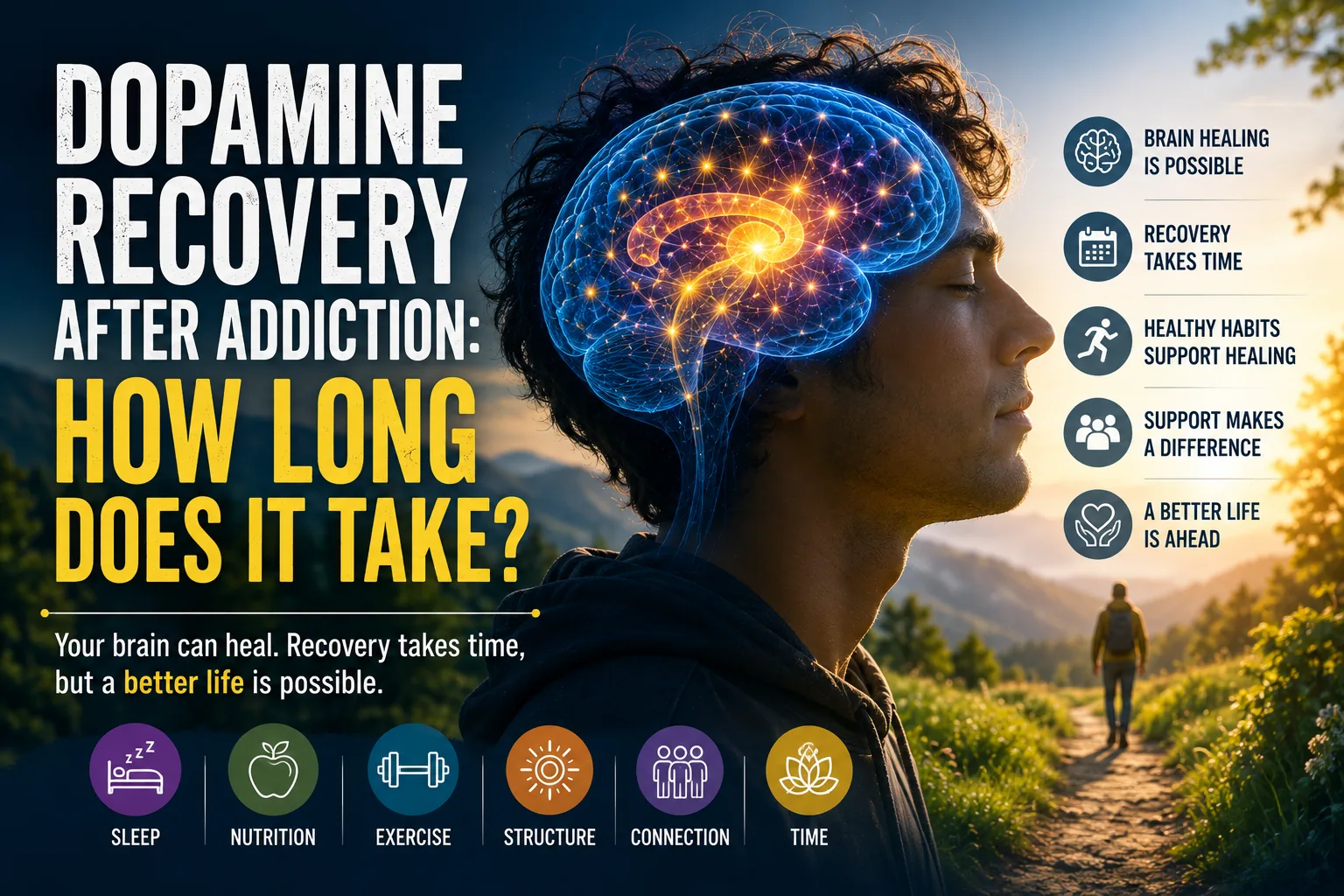


Dopamine recovery after addiction is one of the biggest concerns people have when they stop using drugs or alcohol. Early recovery can feel emotionally flat. Things that once brought happiness may seem boring. Motivation can disappear. Energy may drop. Even spending time with people you love may not feel the same.
That can lead to a frightening question:
“Did I permanently damage my dopamine system?”
In many cases, the answer is no.
The brain can adjust after addiction, and the dopamine system can gradually begin functioning more normally. Understanding how the addicted brain changes during recovery can help explain why these changes happen and why improvement often requires time.
However, how long dopamine takes to recover after addiction varies widely. Some people notice meaningful changes within weeks or months, while others continue improving for a year or longer. Our broader guide to how long the brain takes to heal from addiction explores the larger brain-recovery timeline beyond dopamine alone.
Recovery is rarely instant. It is usually gradual.
What Does Dopamine Do in the Brain?
Dopamine is often called the brain’s “pleasure chemical,” but that description is too simple.
Dopamine plays an important role in:
- Motivation
- Learning
- Attention
- Movement
- Reward
- Reinforcement
- Goal-directed behavior
When something important happens, dopamine helps the brain remember it.
Eat when you’re hungry.
Reach a goal.
Exercise.
Spend time with someone you love.
Finish a difficult task.
Your brain learns:
“That was worth doing.”
Addictive substances can interfere with this natural system.
Some drugs cause powerful increases in dopamine activity or alter the way dopamine signals are transmitted. Over repeated use, the brain begins adapting to those unusually strong signals.
These reward-system changes are only one part of how addiction changes the brain and what happens in recovery. Substance use can also affect stress, memory, judgment, impulse control, learning, and emotional regulation.
Normal rewards may begin feeling weaker.
The drug becomes more important.
How Addiction Changes the Dopamine System
Repeated drug use can change how the brain responds to dopamine.
The exact changes depend on the substance, dose, frequency of use, genetics, and length of addiction.
Someone may eventually need more of the substance to experience the same effect.
At the same time, activities that once felt satisfying may provide very little enjoyment.
That can include:
Exercise.
Food.
Sex.
Work.
Hobbies.
Relationships.
This helps explain why addiction can slowly take over someone’s priorities.
The drug may no longer simply feel good.
The brain may begin treating it as something extremely important.
Stopping does not immediately erase those adaptations.
The reward system has to adjust to a world where drugs or alcohol are no longer producing the powerful signals it learned to expect.
Why You May Feel Depressed or Unmotivated After Getting Sober
One of the hardest parts of early recovery is anhedonia, or difficulty experiencing pleasure.
Someone may think:
“Nothing makes me happy anymore.”
They may also experience:
- Low motivation
- Fatigue
- Poor concentration
- Depression
- Irritability
- Sleep problems
- Anxiety
- Emotional numbness
- Strong cravings
For some people, nothing feels good after getting sober. Food, music, hobbies, relationships, and accomplishments may temporarily seem less rewarding than they did before.
When this reduced ability to experience pleasure becomes significant, learning about anhedonia in addiction recovery can help explain why pleasure may feel different while the reward system adjusts.
Motivation can also disappear. Understanding why motivation is low in early recovery is important because low drive does not necessarily mean someone is lazy or failing at sobriety. Sleep disruption, stress, depression, withdrawal, and changes in reward processing can all make basic tasks feel harder.
These symptoms can make sobriety seem disappointing.
Someone may have expected to stop using drugs and immediately feel better.
Instead, they feel worse.
This does not necessarily mean recovery is failing.
The brain may still be adjusting to life without repeated substance exposure.
How Long Does Dopamine Recovery Take?
There is no exact dopamine recovery timeline.
The first several weeks of sobriety can be especially difficult. Withdrawal, disrupted sleep, stress, nutritional problems, and changes in brain chemistry can all affect mood and motivation.
During the first 30 to 90 days, some people begin noticing improvements.
They may have more energy.
Their thinking becomes clearer.
They start enjoying small activities again.
Cravings may become less constant.
By around six months, some people report more stable moods and stronger motivation.
At one year sober, life can feel dramatically different from early recovery.
But these are not deadlines.
Someone who still feels emotionally flat at six months has not necessarily damaged their brain permanently.
Brain recovery depends on many factors.
The question of whether the brain can fully heal after drug addiction also does not have a universal yes-or-no answer. Many addiction-related changes can improve substantially, while other effects may take longer or depend on whether additional neurological injury occurred.
Brain Fog and Memory Can Recover on a Different Timeline
Dopamine is only one part of the recovery process.
Someone may notice their mood improving while concentration remains difficult.
Another person may feel motivated again but still struggle with forgetfulness.
Brain fog after quitting drugs or alcohol can involve slow thinking, poor concentration, mental fatigue, or difficulty following conversations.
People may also experience memory problems during addiction recovery, especially when sleep, attention, stress, depression, or other cognitive systems are still stabilizing.
These symptoms do not necessarily follow the same timeline as pleasure or motivation.
That is another reason reducing recovery to a single “dopamine reset” timeline can be misleading.
Different Drugs May Have Different Recovery Timelines
Not every substance affects dopamine in exactly the same way.
Methamphetamine can strongly affect dopamine signaling and is often associated with significant problems involving motivation, memory, attention, and reward.
Cocaine rapidly influences dopamine signaling and can create powerful learned associations between drug use and environmental cues.
Opioids affect several brain systems and can change both reward and stress responses.
Alcohol affects multiple neurotransmitter systems rather than dopamine alone.
This means there is no single answer to:
“When will my dopamine be normal again?”
The answer depends partly on what was used and how long the brain was exposed to it.
It is also important to distinguish brain recovery from permanent neurological injury. Addiction-related brain changes are not automatically permanent, but overdose, oxygen deprivation, stroke, traumatic brain injury, severe nutritional deficiencies, and other complications can sometimes cause lasting damage. Our guide to whether addiction can cause permanent brain damage explores that distinction in greater detail.
Dopamine Is Not the Only Thing Recovering
It is tempting to blame every uncomfortable symptom of recovery on “low dopamine.”
Recovery is more complicated than that.
The brain uses many chemical systems, including:
- Dopamine
- Serotonin
- GABA
- Glutamate
- Endorphins
- Norepinephrine
Sleep may also be disrupted.
Stress hormones may be elevated.
Mental health conditions may become more noticeable after substances are removed.
Someone recovering from addiction may therefore experience depression or anxiety for reasons that cannot be explained by dopamine alone.
This is why persistent symptoms deserve professional evaluation rather than relying on internet claims about “dopamine detoxes.”
Can You Speed Up Dopamine Recovery?
There is no proven shortcut that instantly resets the brain’s dopamine system.
Recovery mostly comes from giving the brain time and creating healthier conditions.
Helpful habits include:
Exercise regularly. Physical activity can support mood, sleep, stress management, and overall brain health. Learn more about how exercise can help the brain recover from addiction.
Get consistent sleep. Sleep is essential for memory, emotional regulation, and brain function. Understanding how sleep helps the brain heal from addiction can help explain why protecting sleep is especially important during early recovery.
Eat regularly. Severe nutritional deficiencies can make fatigue and concentration problems worse.
Build structure. A consistent daily recovery routine can reduce boredom and help rebuild motivation.
Stay connected. A strong recovery support system can reduce isolation and provide encouragement during difficult periods.
Treat mental health conditions. Depression, anxiety, ADHD, PTSD, and other conditions may require professional treatment.
Avoid replacing one addiction with another. Constantly chasing intense stimulation can make it harder to build a balanced recovery lifestyle.
The goal is not to force dopamine higher.
The goal is to help the brain relearn healthy rewards.
Ordinary Things Can Start Feeling Good Again
One of the most important changes in recovery is surprisingly simple.
Normal life starts becoming enjoyable.
Coffee in the morning.
A workout.
Cooking dinner.
Music.
A conversation.
A good night’s sleep.
Finishing a project.
Watching your children laugh.
At first, these experiences may seem weak compared with the intense reward associated with drugs.
Then something changes.
You begin looking forward to them.
That is a powerful part of recovery.
The brain is learning that rewards exist outside addiction.
These ordinary rewards may not create the intense rush associated with drugs, but they can provide something addiction rarely does: stability, connection, purpose, and satisfaction that lasts.
Give Your Brain Time to Recover
So, how long does dopamine recovery after addiction take?
There is no universal answer.
Some people begin feeling significantly better within several weeks or months. Others continue noticing improvements throughout the first year and beyond.
Do not measure recovery against someone else’s timeline.
Early sobriety can feel emotionally empty, but early recovery is not necessarily what sober life will feel like forever.
Your brain spent time adapting to addiction.
It also needs time to adapt to recovery.
With continued sobriety, sleep, nutrition, exercise, treatment, healthy routines, and support, the brain has repeated opportunities to change.
The goal is not to chase a perfect dopamine level.
The goal is to build a life that teaches the brain, one day at a time, that healthy things are worth wanting again.


