



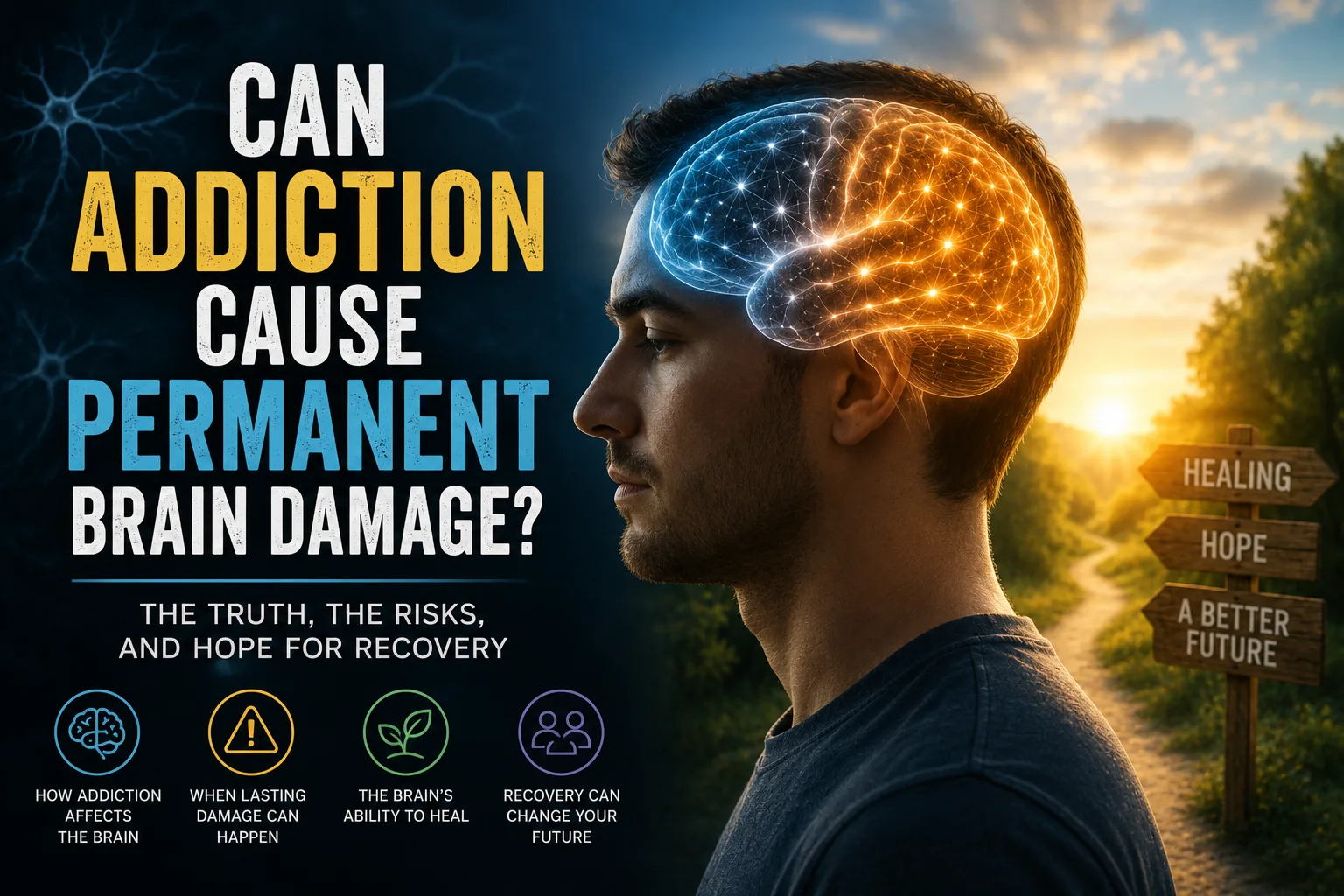


Can addiction cause permanent brain damage? It is a frightening question, especially for someone who has used drugs or alcohol heavily for years and is now trying to recover. Memory problems, poor concentration, mood changes, brain fog, and difficulty feeling pleasure can make it seem like something has been permanently broken.
The truth is more complicated.
Addiction can cause serious changes in the brain, and some complications can lead to lasting neurological damage. At the same time, the brain also has a remarkable ability to adapt and heal during recovery.
Some brain changes improve within weeks or months.
Others may take years.
And in some cases, certain damage may not fully reverse.
The outcome depends on the substance used, how much was used, how long the addiction lasted, overall health, nutrition, age, mental health, and whether serious events such as overdose, stroke, head injury, or oxygen deprivation occurred.
Understanding how addiction changes the brain and what happens during recovery is an important place to start. Addiction-related changes in reward, motivation, memory, stress, and decision-making are not automatically the same as permanent brain injury.
How Addiction Changes the Brain
Repeated substance use can change brain systems involved in:
- Reward
- Motivation
- Memory
- Learning
- Judgment
- Impulse control
- Stress
- Emotional regulation
- Sleep
Many addictive substances affect the brain’s reward pathways.
Over time, the brain can begin treating the substance as something extremely important.
Normal activities may feel less rewarding.
Relationships may matter less.
Work may become less important.
Healthy goals may slowly disappear.
The addicted brain becomes increasingly focused on obtaining, using, and recovering from the substance.
These changes help explain why someone can continue using even when they understand the consequences.
Changes involving dopamine and reward can be especially noticeable. Understanding dopamine recovery after addiction helps explain why motivation, pleasure, and normal rewards may feel different even after substance use stops.
But changes in brain function are not automatically the same thing as permanent brain damage.
Some of these changes can improve when substance use stops.
Can the Brain Heal After Addiction?
Yes.
The brain has an ability called neuroplasticity, which means it can change and reorganize in response to experiences.
Addiction uses this ability in an unhealthy direction.
Recovery can use it in a healthier direction.
When someone stops using drugs or alcohol, the brain begins adjusting again.
Sleep may improve.
Stress responses may become more stable.
Decision-making can become clearer.
Memory may improve.
Natural rewards may begin feeling enjoyable again.
The process is usually gradual.
Understanding The Brain in Addiction Recovery means recognizing that healing does not happen on a fixed schedule.
Some people feel dramatically better after a few months.
Others may continue noticing improvements years into recovery.
Our guide to how long it takes the brain to heal from addiction explores why recovery timelines can vary so widely.
There is also an important difference between asking whether the brain can improve and asking whether it will return completely to its previous state. A deeper look at whether the brain can fully heal after drug addiction explains why substantial healing is possible even though complete reversal of every neurological effect cannot be guaranteed.
When Can Addiction Cause Lasting Brain Damage?
Some situations carry a greater risk of permanent neurological injury.
Overdose and Oxygen Deprivation
An opioid overdose can slow or stop breathing.
When the brain does not receive enough oxygen, brain cells can be injured.
The longer oxygen levels remain dangerously low, the greater the risk of lasting damage.
Someone who survives an overdose may experience:
- Memory problems
- Difficulty concentrating
- Movement problems
- Personality changes
- Speech difficulties
- Cognitive impairment
This is one reason overdose is a medical emergency.
Stroke
Some drugs can increase the risk of stroke.
Stimulants such as cocaine and methamphetamine can place severe stress on the cardiovascular system.
A stroke can damage brain tissue and may cause lasting problems involving movement, speech, memory, or behavior.
Head Injuries
Substance use can increase the risk of falls, car accidents, fights, and other injuries.
Repeated head trauma can affect memory, concentration, mood, and judgment.
Sometimes cognitive problems blamed on addiction may actually be partly related to traumatic brain injury.
Severe Nutritional Deficiencies
Long-term heavy alcohol use can contribute to serious nutritional deficiencies.
Deficiency of certain vitamins, especially thiamine, can affect the brain and nervous system.
In severe cases, this can lead to major memory and cognitive problems.
Nutrition is not a minor issue in addiction recovery.
The brain needs proper fuel to function.
Different Substances Affect the Brain Differently
Not all addictions create the same neurological risks.
Alcohol can affect memory, judgment, coordination, sleep, and brain structure. Long-term heavy use may lead to significant cognitive problems.
Methamphetamine can affect dopamine systems, attention, memory, motivation, and emotional regulation.
Cocaine can affect reward systems and may increase the risk of stroke and cardiovascular complications.
Opioids affect reward, stress, breathing, and alertness. Overdose-related oxygen deprivation can cause serious brain injury.
Benzodiazepines and other sedatives can interfere with memory, attention, and cognitive processing.
Using multiple substances can make the picture even more complicated.
This is one reason there is no universal answer to how much neurological recovery someone can expect.
Brain Fog Does Not Automatically Mean Brain Damage
One of the biggest mistakes people make in early recovery is assuming every memory problem or concentration issue means permanent damage.
Brain fog can happen for many reasons.
Poor sleep.
Withdrawal.
Anxiety.
Depression.
Stress.
Malnutrition.
Medication changes.
Exhaustion.
Cravings.
Imagine trying to concentrate while sleeping badly, worrying constantly, and adjusting to life without a substance your brain depended on.
Of course thinking may feel slower.
For many people, mental clarity improves as recovery continues.
Our guide to brain fog after quitting drugs or alcohol explains why slow thinking, poor concentration, and mental exhaustion can occur during recovery without necessarily indicating permanent neurological injury.
Memory Problems May Improve With Time
Memory is one of the biggest concerns people have after long-term substance use.
You may forget appointments.
Lose your train of thought.
Forget conversations.
Struggle to learn new information.
These problems can be frustrating, but improvement is possible.
Better sleep can improve memory.
Reduced stress can improve concentration.
Exercise can support brain health.
Proper nutrition matters.
Mental health treatment can help.
Continued sobriety gives the brain more time to recover.
The change may be slow enough that you barely notice it.
Then one day you realize you are reading more easily, remembering conversations, or performing better at work.
For a closer look at why forgetfulness can occur and what may help, read about memory problems during addiction recovery.
Difficulty Feeling Pleasure Does Not Automatically Mean Permanent Damage
Some people become worried because sobriety does not feel enjoyable.
Food seems ordinary.
Music does not create the same emotional response.
Hobbies feel boring.
Relationships seem less rewarding.
Someone may begin asking why nothing feels good after getting sober.
A reduced ability to experience pleasure is known as anhedonia. Understanding anhedonia in addiction recovery can help explain why emotional flatness may occur while the brain’s reward systems are still adapting.
These experiences can feel frightening.
But emotional numbness alone does not prove permanent brain damage.
For many people, ordinary rewards gradually become meaningful again.
Low Motivation Can Also Improve
Another common fear is:
“Why don’t I care about anything anymore?”
Low motivation can make someone feel fundamentally changed.
Getting out of bed feels difficult.
Exercise sounds impossible.
Work takes more effort.
Even making a phone call can feel exhausting.
Learning why motivation is low in early recovery helps explain how changes in reward, sleep, stress, mood, and energy can all affect the desire to take action.
Motivation may return gradually.
Sometimes action has to come first.
A walk.
A shower.
One appointment.
One task completed.
One promise kept.
Those small actions can become part of the brain’s recovery process.
Sleep and Exercise Can Support Brain Health
There is no treatment that instantly reverses every neurological effect associated with addiction.
But creating healthier conditions matters.
Sleep is especially important.
Poor sleep can worsen memory, concentration, mood, decision-making, stress, and emotional control. Addiction and withdrawal can both disrupt normal sleep patterns.
Understanding how sleep helps the brain heal from addiction can help explain why consistent rest is one of the basic building blocks of recovery.
Exercise can also play a supportive role.
Movement can improve physical health, sleep, mood, stress management, and daily structure. Our guide to how exercise can help the brain recover from addiction looks at why physical activity can be useful alongside treatment and other recovery supports.
Neither sleep nor exercise guarantees complete neurological healing.
But both can help create conditions that support brain and body health.
Relapse Can Create New Risks
A relapse does not mean every previous improvement has disappeared.
However, returning to substance use can create serious risks.
Tolerance often drops during periods of sobriety.
If someone returns to the amount they previously used, overdose risk can increase.
Another overdose means another chance for oxygen deprivation and brain injury.
That is why relapse should be taken seriously and followed by renewed treatment, support, and prevention planning.
It is not proof that recovery failed.
It is a warning that the recovery plan may need to become stronger.
When Should You Seek Medical Help?
Persistent cognitive or neurological symptoms deserve medical attention.
Talk with a healthcare professional if you experience:
- Severe memory loss
- Confusion
- Personality changes
- Weakness
- Difficulty speaking
- Seizures
- Problems walking
- Significant balance problems
- Severe depression
- Rapidly worsening concentration
A history of overdose, stroke, heavy alcohol use, or head injury makes evaluation especially important.
Do not assume every symptom is simply part of getting sober.
Likewise, do not assume every uncomfortable recovery symptom means permanent brain damage.
Medical evaluation can help distinguish between conditions that may improve with time and problems that require additional treatment.
Recovery Can Still Change Your Future
So, can addiction cause permanent brain damage?
Yes, it can in some circumstances.
But addiction-related brain changes are not automatically permanent.
The brain can continue adapting during recovery.
Thinking may become clearer.
Memory can improve.
Motivation can return.
Normal activities can become enjoyable again.
Sleep can stabilize.
Emotions can become easier to manage.
And healthier choices can become easier with practice.
The goal is not to spend recovery wondering whether your brain will ever be exactly what it was before addiction.
The goal is to give it the healthiest environment possible from this point forward.
Protect your sleep.
Exercise.
Eat well.
Treat mental and physical health conditions.
Stay connected to treatment.
Build relationships.
Avoid another overdose.
Give recovery time.
Every day without harmful substance use gives the brain another opportunity to heal, adapt, and build a stronger future.


