



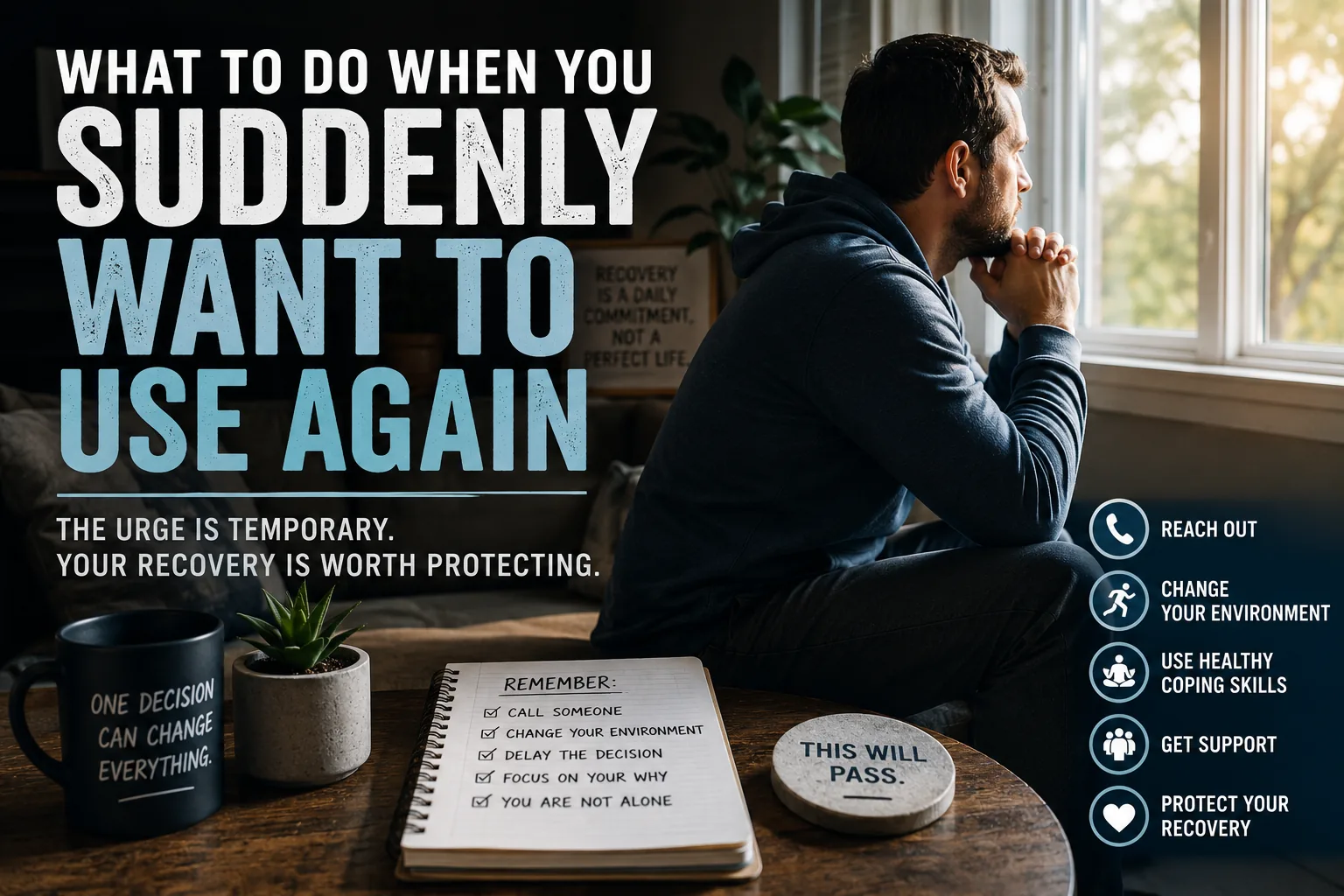


What should you do when you suddenly want to use again? First, recognize that having an urge does not erase your progress. A strong craving can appear even when you are committed to recovery, and sometimes it seems to come out of nowhere.
One minute you feel fine.
Then suddenly you are thinking about drinking, getting high, calling someone from your past, or returning to a place connected with substance use.
The urge may feel urgent.
“I need to use right now.”
But a craving is not a command.
What you do during the next few minutes can make an enormous difference. Instead of debating whether you should use, focus on creating time and distance between the craving and the opportunity to act on it.
You do not have to solve the rest of your recovery tonight.
You only have to protect it right now.
Stop and Change Your Environment
When a sudden urge appears, your first move should often be physical.
Change where you are.
If you are outside an old bar, leave.
If someone around you is using, get away from them.
If you are driving toward somewhere connected with drugs, turn around.
If you are alone and becoming overwhelmed, go somewhere safe where other people are present.
Changing your surroundings can interrupt the pattern between thought and action.
You can also:
- Call someone you trust
- Take a walk
- Go to a recovery meeting
- Exercise
- Eat something
- Drink water
- Take a shower
- Sit somewhere public and safe
Our guide on how to handle drug or alcohol cravings without using offers additional ways to get through an urge without returning to substances.
Do not stay in a high-risk environment because you want to prove you can handle it.
Leaving is not weakness.
It is a recovery decision.
Figure Out What Triggered the Urge
Once you are somewhere safe, think about what happened immediately before the craving.
Were you angry?
Lonely?
Bored?
Tired?
Stressed?
Did someone mention drugs?
Did you hear a song connected with using?
Did you drive through an old neighborhood?
Did you receive upsetting news?
The addicted brain can form powerful connections between substances and people, places, emotions, and experiences.
These connections can later become triggers.
Learning how to deal with triggers in addiction recovery can help you recognize patterns before they become dangerous.
Sometimes the trigger is obvious.
Other times it may take several cravings before you notice the pattern.
Keep track.
If every argument with one person makes you want to drink, that tells you something.
If payday repeatedly makes you think about drugs, that tells you something too.
Triggers become easier to manage when they stop being surprises.
Remember That Cravings Pass
During a strong craving, your brain may tell you:
“This will not stop until I use.”
That feeling can be convincing.
But cravings change.
They can rise quickly, become intense, and then begin to fade.
Understanding how long drug cravings can last after quitting can help you remember that the urge you feel right now is temporary.
Try delaying any decision.
Tell yourself:
“I am not using for the next 20 minutes.”
Then do something else.
Call someone.
Walk.
Watch something.
Clean.
Eat.
Exercise.
Write down exactly what you are thinking.
When 20 minutes pass, choose another 20.
You do not need to promise yourself that you will never experience another craving.
You simply need to avoid acting on this one.
Cravings may even return after long periods of sobriety. Understanding why cravings can come back months or years into recovery can help you avoid interpreting an unexpected urge as proof that you have failed.
Tell Someone Before the Craving Becomes a Plan
Cravings become more dangerous when they stay secret.
You may start with:
“I feel like using.”
Then your thoughts change.
“Maybe I could do it once.”
Then:
“I know someone I could call.”
Then:
“I could be there in twenty minutes.”
The closer you get to making a plan, the more important it becomes to involve someone else.
Call a sponsor.
A friend.
A family member.
Someone from treatment.
A recovery peer.
Tell them exactly what is happening.
Say:
“I really want to use right now and I need help getting through it.”
You do not need to make the situation sound better than it is.
A sudden craving does not automatically mean you are about to relapse, but making plans to obtain or use substances is a serious warning sign.
Get support early.
It is much easier to interrupt the process before drugs or alcohol are in front of you.
Watch for Stress and High-Risk Situations
Sudden cravings often happen when your defenses are already low.
You are exhausted.
Work has been terrible.
Your relationship is struggling.
Money is tight.
You are grieving.
Stress can make old coping patterns look attractive again.
That is why learning how to stay sober during stressful times is important even when recovery has been going well.
Social situations can also create sudden urges.
You may arrive at a party feeling completely confident.
Then someone hands you a drink.
Everyone starts drinking.
Your old memories come back.
Having a plan for staying sober at parties and social events gives you options before you become overwhelmed.
Holidays can bring similar risks because they combine family stress, traditions, travel, grief, and alcohol. Preparing for staying sober during the holidays can prevent a predictable trigger from becoming an emergency.
You are allowed to protect yourself.
You can decline the invitation.
Leave early.
Bring someone supportive.
Drive yourself so you can leave.
Recovery does not require testing your limits.
Protect the Life You Have Built
A sudden desire to use can make the moment feel bigger than everything else.
Try to zoom out.
Remember what addiction actually cost you.
Remember why you stopped.
Think about what recovery has given you.
Your health.
Relationships.
Trust.
Freedom.
A job.
A home.
Peace.
Maybe you are still building those things.
They still matter.
Knowing how to protect your recovery when life gets difficult can help you prepare before the next difficult period arrives.
Your recovery may need more support at certain times.
That is normal.
The sobriety timeline is not a straight line where every month becomes easier than the one before it.
Life changes.
Stress changes.
Triggers change.
What matters is continuing to respond.
If you suddenly want to use again, do not treat the craving like a secret failure.
Treat it like information.
Something triggered your brain.
Something needs attention.
Change your environment.
Reach out.
Delay the decision.
Remember the consequences.
Protect what you have built.
Wanting to use again does not mean you have lost your recovery. The craving is a moment. What you choose to do during that moment can protect everything you have worked so hard to build.


