





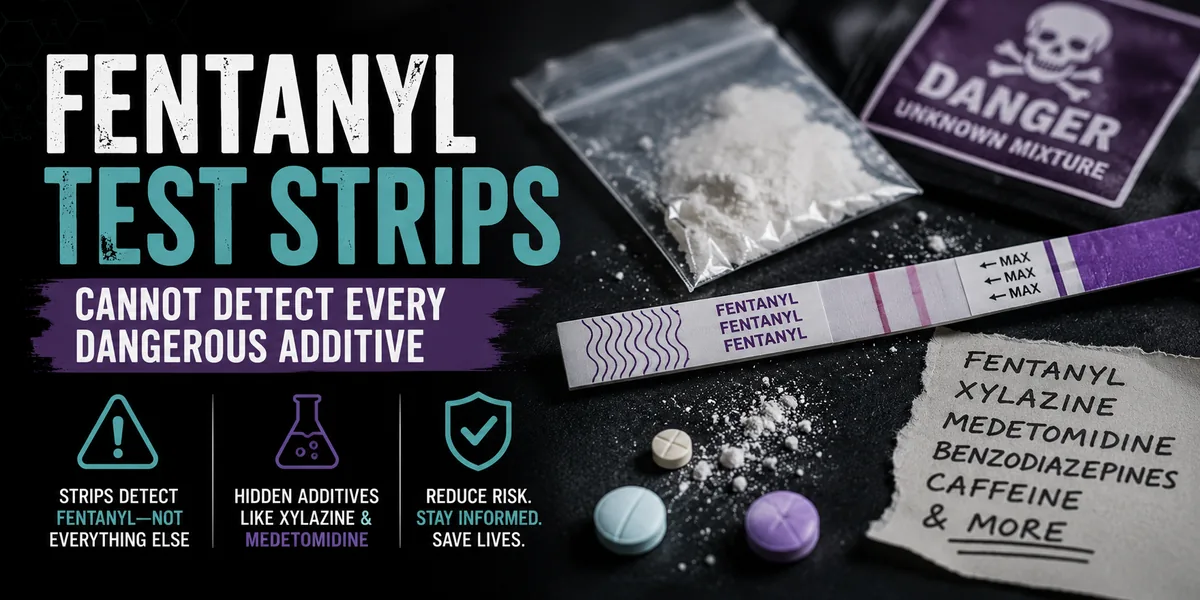
Fentanyl test strips can be an important harm-reduction tool, but they are not a complete safety test. A strip may reveal that fentanyl is present in a pill, powder, or liquid. It cannot tell someone every substance in the sample, how strong the fentanyl is, or whether the product is safe to use. As the illegal drug supply changes, dangerous additives such as xylazine and medetomidine may be present even when a fentanyl test produces the result someone expected.
The CDC warns that no drug test strip is perfect. False-negative results can occur, and some fentanyl-like substances—including carfentanil—may not be reliably detected. A negative result should never be treated as proof that a drug is safe.
What Fentanyl Test Strips Actually Detect
A fentanyl test strip is designed to identify fentanyl and, depending on the strip, certain closely related compounds. It provides a basic positive-or-negative result. It is not a laboratory analysis of everything in the product.
This means a positive result answers only one question: was a detectable amount of fentanyl or a recognized related compound present in the tested sample? It does not show how many milligrams are present, whether the dose is likely to be fatal, or how evenly fentanyl is distributed throughout the product.
The amount of fentanyl can vary dramatically within the same bag, powder, or counterfeit pill. Testing one small portion may not reflect another portion. NIDA notes that a tested sample may miss fentanyl even when another part of the product contains it.
A strip also cannot identify most unrelated drugs. A product may contain fentanyl along with tranquilizers, stimulants, benzodiazepines, fillers, or newly emerging synthetic substances. The fentanyl result provides no information about those additional ingredients.
Why Xylazine Is Not Detected by a Fentanyl Strip
Xylazine is a nonopioid veterinary sedative increasingly found in the illegal drug supply. It may be mixed with fentanyl, heroin, cocaine, or other substances without the person’s knowledge.
Because xylazine is chemically different from fentanyl, an ordinary fentanyl test strip does not test for it. Separate xylazine test strips are commercially available, but they must be used as a different test. Even those strips can have limitations, including false-positive results under certain conditions.
Xylazine can cause severe sedation, slowed heart rate, dangerously low blood pressure, difficulty breathing, serious skin wounds, withdrawal, and death. Naloxone does not reverse xylazine itself, although naloxone should still be given because fentanyl is often present.
A fentanyl-positive result therefore does not reveal whether xylazine is also in the drug. A fentanyl-negative result does not rule out xylazine either.
Medetomidine Creates Another Testing Gap
Medetomidine is another veterinary sedative now appearing in parts of the illegal fentanyl supply. Like xylazine, it is not an opioid and requires its own specific testing method.
The CDC reports that separate test strips may be available for fentanyl, xylazine, and medetomidine. One strip does not automatically test for all three. Even when multiple strips are used, false-negative results remain possible.
Medetomidine can cause prolonged sedation, a very slow heart rate, and low blood pressure. Repeated exposure may also lead to severe withdrawal involving vomiting, agitation, shaking, a rapid heartbeat, and dangerously high blood pressure. These effects can continue after naloxone reverses the fentanyl portion of an overdose.
A person could therefore test a product for fentanyl, receive a positive result, and still have no idea that medetomidine is present. The test is not wrong; it simply was not designed to answer that second question.
Some Fentanyl-Like Drugs May Be Missed
Even within the opioid category, test-strip performance can vary. The CDC specifically warns that some strips may not detect highly potent fentanyl-like drugs such as carfentanil.
Carfentanil is a fentanyl analog that is far more potent than fentanyl. CDC surveillance found that overdose deaths involving carfentanil increased roughly sevenfold from the first half of 2023 to the first half of 2024, with detections reported across 37 states.
A strip may also react differently to different analogs depending on the product’s design and the amount present. Some test strips recognize several fentanyl analogs well, while others require a greater concentration before showing a positive result.
This is why a negative test cannot guarantee that no dangerous synthetic opioid is present.
False Negatives, False Positives and Sampling Problems
Test-strip accuracy depends on several factors: the strip brand, storage conditions, expiration date, dilution, instructions, lighting, the substance being tested, and how the sample was collected.
A false negative occurs when fentanyl is present but the strip does not detect it. This can happen if the tested portion contains little or no fentanyl, the concentration is below the strip’s detection limit, or the compound is one the strip does not recognize well.
False positives can also happen. Research has found that high concentrations of substances such as methamphetamine, MDMA, cocaine, and certain cutting agents may interfere with some fentanyl test strips. Correct dilution and following the specific manufacturer’s instructions are important.
Even a correct positive result cannot determine potency. A faint or dark line does not reliably show how much fentanyl is present. Test strips are screening tools, not measuring devices.
Test Strips Should Be One Part of Overdose Prevention
Fentanyl test strips can still save lives by warning people that fentanyl is present where they did not expect it. The limitation is not that the strips are useless. The limitation is that they answer a narrow question in a drug supply containing an expanding number of substances.
People at risk should carry naloxone, avoid using alone, avoid mixing sedating substances, and call 911 when someone cannot be awakened or has slow or stopped breathing. Naloxone should be given during a suspected opioid overdose even when xylazine or medetomidine may also be involved.
Community drug-checking programs may use several test strips or more advanced laboratory equipment to provide a broader picture. Even these services cannot make an illegal product risk-free because drug composition can change between samples and batches.
The safest way to understand fentanyl test strips is this: a positive result is a warning, while a negative result is not permission. The strip can provide useful information, but it cannot detect every additive, predict every interaction, or guarantee that the next dose will not cause an overdose.


