



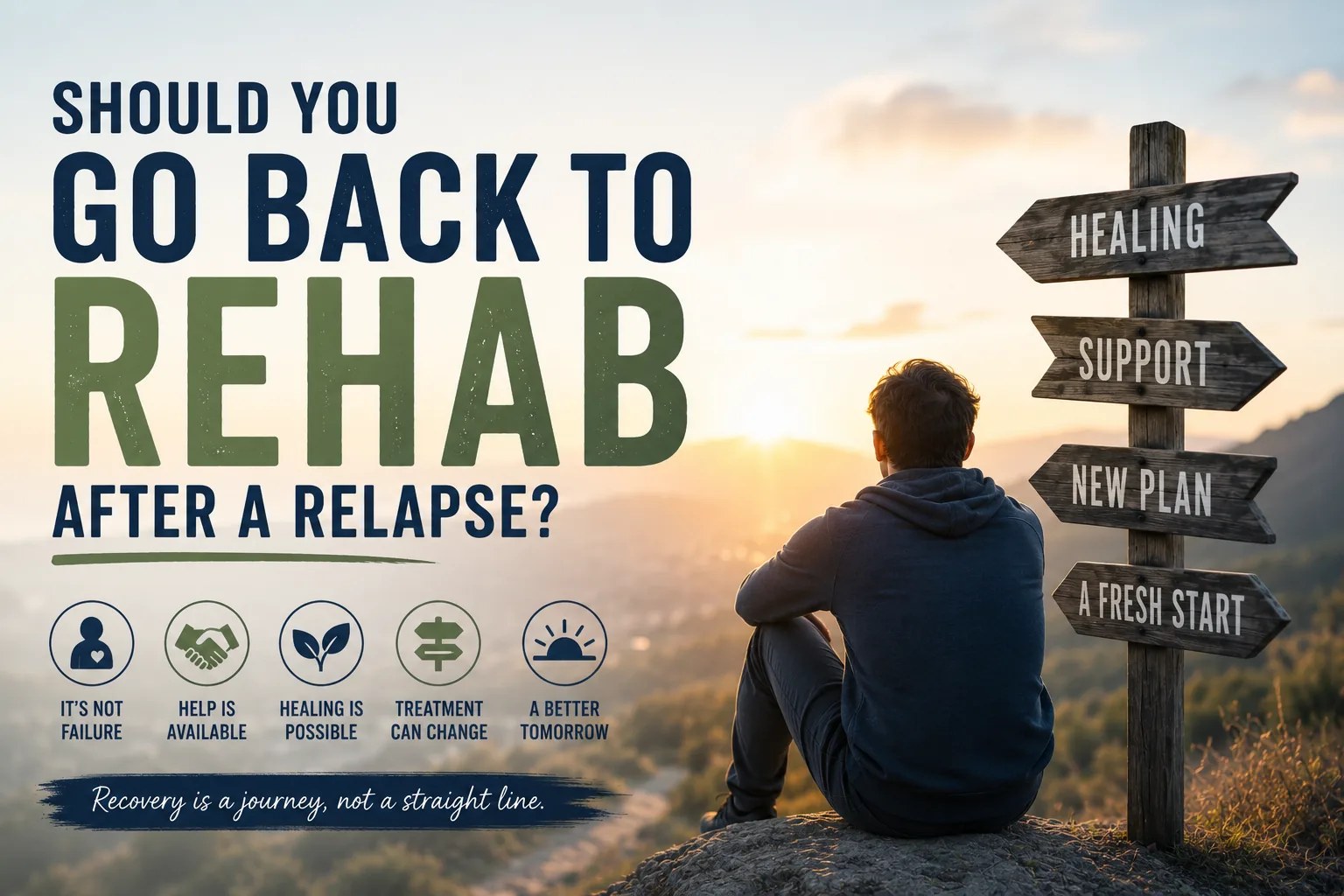


If you have returned to drugs or alcohol after a period of recovery, you may be asking, “Should I go back to rehab after a relapse?” For many people, returning to treatment is the safest choice—but that does not always mean repeating the same residential program.
A relapse is a warning that your current recovery plan is no longer providing enough protection. It does not mean you are weak, hopeless, or back at the beginning. Substance use disorders often require ongoing care, reassessment, and changes in treatment over time. SAMHSA explains that relapse does not mean treatment failed. It may mean treatment needs to be restarted, adjusted, or made more intensive.
Your next step could include medical detox, residential rehab, partial hospitalization, intensive outpatient treatment, medication, counseling, recovery housing, or stronger peer support. The right choice depends on your safety, health, substance use, living environment, and ability to stop.
When Should You Go Back to Rehab After a Relapse?
You should seek a professional assessment when the relapse continues beyond a brief episode, you cannot stop on your own, or your substance use is becoming more frequent or dangerous.
Returning to rehab may also be appropriate when you are:
- Hiding your drinking or drug use
- Missing work, school, or family responsibilities
- Driving or taking other risks while impaired
- Experiencing legal, financial, or relationship problems
- Spending most of your time getting, using, or recovering from substances
- Repeatedly trying and failing to stop
- Pulling away from treatment and supportive people
A higher level of care may be especially helpful when your home is filled with alcohol, drugs, conflict, stress, or people who continue to use. Residential treatment creates distance from those triggers while providing structure, supervision, counseling, and time to stabilize.
Mental health symptoms also matter. Depression, severe anxiety, trauma symptoms, paranoia, mania, or suicidal thoughts can make it harder to stop using. A treatment program that addresses both substance use and mental health may offer more support than trying to manage each problem separately.
Addiction professionals use comprehensive assessments to determine the appropriate level of care. These evaluations consider withdrawal risk, physical health, mental health, readiness for change, relapse potential, and the safety of the person’s recovery environment.
Does One Slip Mean You Need Residential Rehab?
Not necessarily. A brief lapse followed by immediate honesty and a quick return to recovery may be addressed without a long residential stay. However, it should not be ignored.
Contact your counselor, sponsor, recovery coach, doctor, or previous treatment center as soon as possible. Explain what happened, what you used, how much you used, and whether you believe you can stop safely.
A professional assessment is more useful than judging the situation only by how many days you used. Someone who used once but experienced an overdose, dangerous behavior, or severe mental health symptoms may need more help than someone who returned to use briefly and immediately reached out for support.
You may not need to repeat the exact treatment program you completed before. Treatment should be matched to what you need now. ASAM recommends regularly reassessing people in addiction treatment and moving them to a more or less intensive level of care as their needs change.
Possible options include medical detox, residential care, partial hospitalization, intensive outpatient treatment, standard outpatient counseling, peer support, and medication.
Medications such as methadone, buprenorphine, and naltrexone are evidence-based treatments for opioid use disorder. Medications are also available for alcohol use disorder. These treatments can reduce cravings and help people remain engaged in recovery.
What Should You Do Immediately After a Relapse?
First, get to a safe place and tell someone you trust. Do not remain alone if you are heavily intoxicated, at risk of overdose, experiencing dangerous withdrawal symptoms, or afraid you will continue using.
Call 911 if someone:
- Cannot be awakened
- Has stopped breathing or is breathing very slowly
- Has blue or gray lips or fingertips
- Experiences a seizure
- Collapses or becomes severely confused
- Talks about suicide or harming someone
Opioid relapse can be especially dangerous because tolerance may decrease during a period of abstinence. A dose that once seemed familiar can cause a fatal overdose after time away from opioids. Naloxone can rapidly reverse an opioid overdose, but emergency services should still be called immediately.
People who have been drinking heavily or regularly using benzodiazepines should also speak with a medical professional before suddenly stopping. Withdrawal may require medical supervision.
Once you are safe, contact a treatment provider. Remove remaining drugs or alcohol from your surroundings with help from someone you trust. Avoid people and places connected to the relapse. Do not spend several days trying to prove that you can control the situation alone.
Then examine what happened before the relapse. Were you isolating, skipping appointments, sleeping poorly, feeling overwhelmed, arguing with loved ones, or spending time around people who use? The goal is not to punish yourself. It is to identify the weakness in your recovery plan and strengthen it.
Going Back to Rehab Is Not Starting Over
Returning to treatment can feel embarrassing. Shame may tell you to hide what happened or wait until the situation becomes worse. Recovery asks you to do the opposite: tell the truth and accept help early.
The time you spent sober still matters. You learned coping skills, rebuilt parts of your life, and proved that change is possible. A relapse cannot erase that progress. It may simply show that you need more structure, different treatment, medication, stronger support, or more time away from triggers.
So, should you go back to rehab after a relapse? When you cannot stop, face dangerous withdrawal, repeatedly return to use, live in an unsafe environment, or struggle with serious mental health symptoms, a higher level of care may be the safest choice.
Even when residential rehab is not necessary, reconnecting with professional treatment should happen quickly. Asking for help after a relapse is not failure. It is an important step toward protecting your health, your recovery, and your future.


