



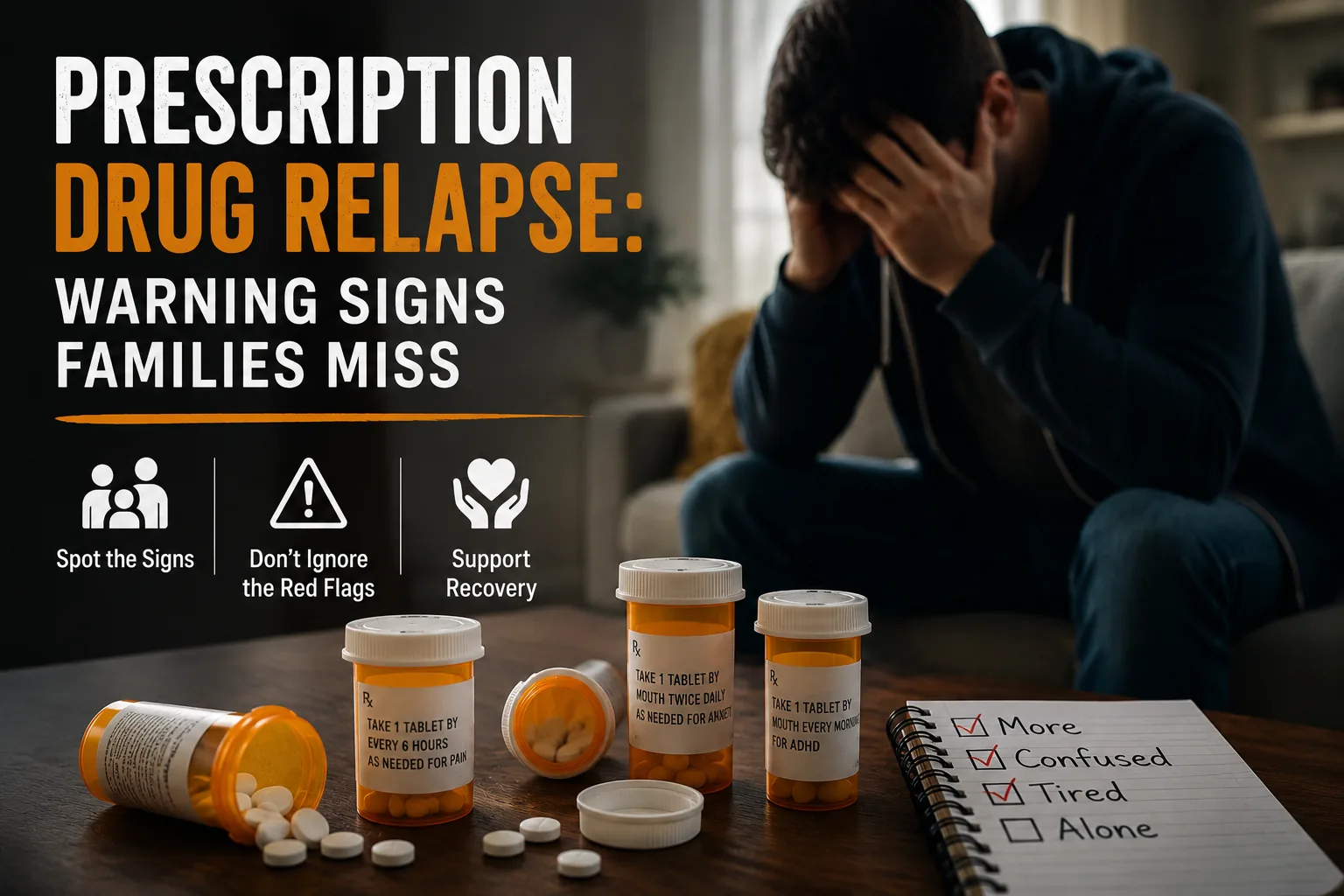


A prescription drug relapse can be surprisingly easy for families to miss. There may be no needles, street dealers, or obvious drug paraphernalia. Instead, the substance may come in an orange pharmacy bottle with the person’s name printed on it.
Prescription opioids, benzodiazepines, and stimulants all have legitimate medical uses, but they can also be misused and may lead to dependence or addiction.
That can make relapse confusing. A loved one may actually have pain, anxiety, ADHD, or insomnia. Families may hesitate to question medication use because they do not want to accuse someone who genuinely needs treatment.
The key is not simply whether the person has a prescription.
Look for changes in the way the medication is being used and changes in the person’s behavior.
Early Prescription Drug Relapse Warning Signs
Relapse often begins quietly.
A family may notice small changes but explain them away individually. One missed family dinner does not prove drug use. Neither does sleeping late or becoming irritable.
A pattern is more important.
Watch for changes such as:
- Running out of medication earlier than expected
- Taking more than the prescribed dose
- Frequently claiming medication was lost, stolen, spilled, or misplaced
- Becoming defensive when asked about medication
- Visiting multiple doctors, pharmacies, or urgent-care clinics
- Asking relatives for their unused medications
- Keeping pills in several different locations
- Becoming unusually secretive
- Suddenly needing more money
- Changes in sleep or appetite
- Neglecting work, school, parenting, or household responsibilities
- Losing interest in hobbies and family activities
- Returning to friends or environments connected with past drug use
SAMHSA identifies unexplained financial problems, major changes in friends or activities, deteriorating appearance, and continued substance use despite relationship problems among possible signs of substance-related problems.
None of these signs alone proves relapse. Together, however, they may justify a calm conversation.
Changes Around the Medication Bottle
Families sometimes focus so much on behavior that they overlook the medication itself.
Pay attention to how quickly prescriptions disappear.
Someone prescribed one tablet twice per day should not repeatedly be out of medication far before the refill date without a clear explanation.
You may also hear statements like:
“The doctor said I could take an extra one if I needed it.”
“I accidentally dropped half the bottle.”
“Someone stole my medication.”
“My prescription isn’t working anymore, so I need more.”
Any one explanation may be legitimate. Repeated emergencies surrounding controlled medications deserve closer attention.
Tolerance can also develop with certain prescription drugs, meaning a person may feel they need larger amounts to get the same effect. Physical dependence and addiction are not identical, but dependence can complicate efforts to stop some medications. The FDA specifically warns that benzodiazepines can cause physical dependence and withdrawal even when used as prescribed.
Different Prescription Drugs Can Look Different
Not every prescription drug relapse looks the same.
Prescription opioids
Medications such as oxycodone, hydrocodone, morphine, and codeine can cause sedation and carry overdose risk.
Families may notice unusual sleepiness, slowed behavior, poor coordination, periods of appearing unusually relaxed, or repeatedly running out of pain medication.
One especially dangerous sign is combining opioids with other depressants.
Benzodiazepines
Medications such as Xanax, Klonopin, Ativan, and Valium may cause sedation and impaired coordination. Families may notice slurred speech, memory gaps, unusual sleepiness, confusion, or behavior that seems similar to alcohol intoxication.
Combining benzodiazepines with opioids or alcohol is particularly dangerous because these substances can increase sedation and suppress breathing.
Benzodiazepines also should not simply be taken away from someone who has become physically dependent. Abrupt discontinuation can cause serious withdrawal reactions, including seizures.
Prescription stimulants
Prescription stimulants used for conditions such as ADHD can also be misused.
Families may notice someone staying awake unusually long, taking medication at strange hours, losing appetite, becoming increasingly anxious or irritable, talking rapidly, or repeatedly increasing the dose.
Stimulants can affect sleep, appetite, blood pressure, heart rate, mood, and behavior.
The important point is that a prescription drug relapse may not look like the person’s previous addiction.
The substance may have changed.
The behavior often tells the story.
What Families Should Do When They Suspect Relapse
Start with a conversation, not an interrogation.
Try:
“I’ve noticed you’ve run out of your medication early three times this month, you’re sleeping most of the day, and you haven’t been going to work. I’m worried about you. What’s going on?”
That approach focuses on observable behavior.
Avoid:
“You’re obviously using again.”
Accusations can quickly turn the conversation into an argument about whether the family can prove drug use.
Your goal is not to win a courtroom case.
Your goal is to get the person connected with help.
Contacting the prescribing clinician can also be important, particularly when a controlled medication may be involved. Treatment for substance use disorders can include counseling, structured outpatient or residential treatment, peer support, and medications when appropriate. For opioid use disorder specifically, FDA-approved treatments include medications such as buprenorphine, methadone, and naltrexone.
Families can also seek their own support. SAMHSA notes that counseling, family support, and support groups can help families cope with substance use problems and participate more effectively in recovery.
Know When It Is an Emergency
Prescription drug relapse can become life-threatening.
Call 911 if someone cannot be awakened, stops breathing normally, has blue or gray lips or fingertips, experiences a seizure, collapses, or appears severely confused.
If an opioid overdose may be involved, administer naloxone if available and call emergency services. SAMHSA identifies inability to wake, slowed or stopped breathing, and choking or gurgling sounds as major opioid overdose warning signs.
Do not assume that because the drug originally came from a pharmacy, the situation is safe.
Families Often Notice the Pattern Before the Person Admits It
Relapse does not always announce itself.
Sometimes it looks like a prescription disappearing too quickly.
Sometimes it looks like sleeping all afternoon.
Sometimes it is another story about a lost medication bottle.
Sometimes it is money disappearing, appointments being missed, or someone slowly pulling away from the people who know them best.
Families should avoid jumping to conclusions, but they should also trust patterns they repeatedly observe.
Ask questions.
Pay attention to changes.
Encourage professional help early rather than waiting for a crisis.
A prescription drug relapse does not mean recovery is over. It may mean the treatment plan needs to change, the underlying pain or mental health condition needs more attention, or the person needs a stronger level of addiction support.
Catching those warning signs early may give your loved one the opportunity to return to recovery before a quiet relapse becomes a medical emergency.


