





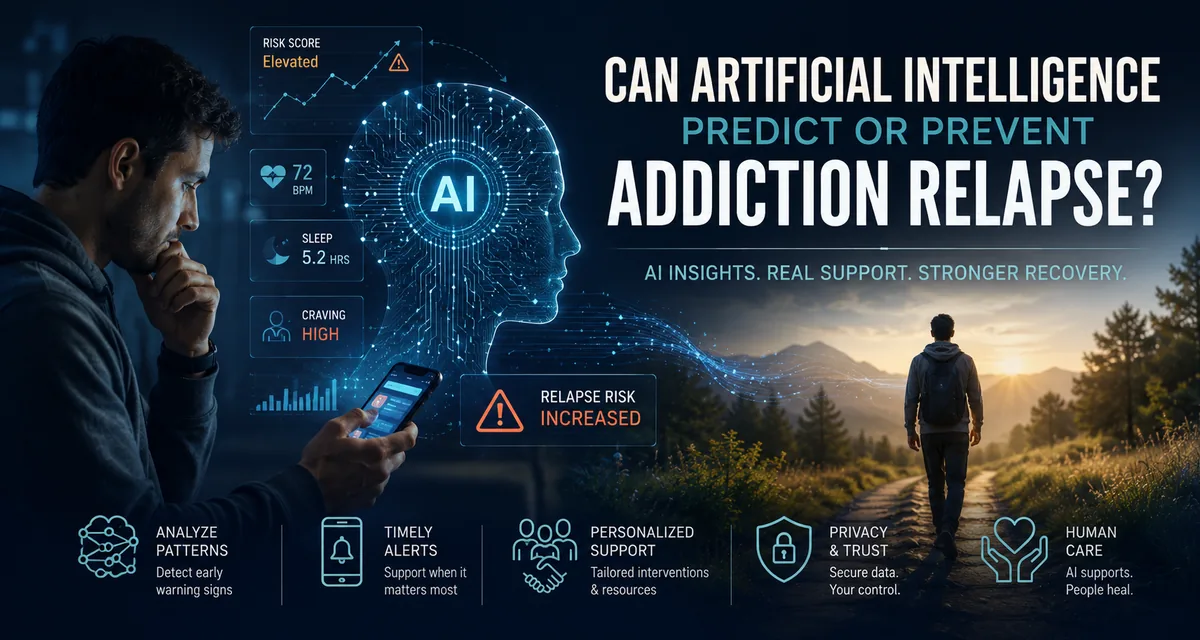
Artificial intelligence may eventually help doctors recognize when someone is at increased risk of returning to alcohol or drug use. Researchers are already testing systems that analyze treatment records, smartphone activity, wearable-sensor data, cravings, sleep patterns, stress, and medication adherence.
But AI cannot predict addiction relapse with certainty. It cannot read someone’s mind, remove cravings, or replace treatment. The technology is better understood as an early-warning system that may notice patterns humans could miss.
The real promise is not simply predicting that relapse might happen. It is using that warning to provide useful support before the person returns to substance use.
How AI Tries to Predict Relapse
Traditional relapse prevention depends heavily on appointments and self-reports. A counselor may ask about cravings, stress, sleep, relationships, and exposure to triggers. These conversations are valuable, but they provide only a snapshot of the person’s life.
AI systems can examine larger amounts of information over time. Depending on the program, that information might include:
- Changes in sleep or physical activity
- Missed appointments
- Medication adherence
- Self-reported cravings
- Stress and mood ratings
- Heart rate or skin-response data
- Changes in phone use or daily routines
- Previous substance use and treatment history
Machine-learning models look for combinations of changes that occurred before earlier episodes of substance use. For example, a system might detect that a person has been sleeping less, reporting stronger cravings, missing medication doses, and becoming less active. Together, those changes may suggest rising risk.
A 2025 study involving people receiving medication treatment for opioid use disorder used app-based daily assessments and deep-learning models to predict non-prescribed opioid use, medication nonadherence, and treatment retention. The study shows that AI can analyze changing, real-world information rather than relying only on a one-time assessment.
Other researchers have combined smartphone questionnaires with wearable devices to search for physical and behavioral changes before a return to drug use. These studies remain early, but they suggest that stress, craving, movement, and physiological signals could someday contribute to personalized warnings.
Can AI Actually Prevent a Relapse?
A prediction by itself does not prevent anything. Prevention depends on what happens after the warning.
An effective system might respond by offering a coping exercise, reminding the person to take medication, suggesting contact with a sponsor, or helping schedule an earlier appointment. With the person’s consent, it might notify a treatment provider or trusted recovery contact.
This approach is sometimes called a just-in-time intervention because support arrives when the person may need it most. One digital-recovery project known as Realize, Analyze, Engage was designed to detect stress and craving through wearable data and deliver immediate support during high-risk moments. Researchers have tested whether machine learning can identify these states from continuous physiological information.
AI could also help treatment teams decide where to focus limited resources. A clinic might use a risk score to identify patients who need additional check-ins, transportation help, medication support, or a faster follow-up appointment.
For someone recovering from opioid addiction, an alert could encourage continued use of prescribed buprenorphine or methadone, connection with treatment, and access to naloxone. For alcohol recovery, it might prompt the person to contact support before entering a high-risk situation.
However, predicting risk and improving outcomes are two different achievements. A model might correctly identify that someone is struggling without proving that its alerts reduce substance use, overdose, or treatment dropout. Large clinical trials are still needed to show which interventions truly help.
Why Relapse Prediction Is So Difficult
Relapse rarely has one simple cause. It may involve grief, pain, trauma, withdrawal, untreated depression, housing problems, loneliness, access to drugs, family conflict, or an unexpected crisis.
A phone cannot see every part of a person’s life. Someone may leave their device at home, stop wearing a watch, answer questions inaccurately, or change routines for reasons unrelated to substance use. A night of poor sleep might signal rising relapse risk, but it could also mean the person has a sick child or an overnight work shift.
This creates two major problems.
A false positive happens when the system warns that relapse is likely even though the person is doing well. Too many false alarms may feel intrusive and cause people or clinicians to stop paying attention.
A false negative happens when the system reports low risk even though the person is close to using. This could create false reassurance during a dangerous period.
Early addiction studies have shown that machine learning can identify meaningful patterns, but the research includes different substances, populations, data sources, and definitions of relapse. A systematic review found growing use of supervised learning, reinforcement learning, and other AI methods in addiction research, but the field remains too varied to support one universal prediction model.
Privacy, Bias and the Risk of Digital Surveillance
Relapse-prediction tools may collect extremely sensitive information. Location, movement, sleep, heart rate, medical records, and phone behavior can reveal far more than substance use.
Patients need to know what is collected, who can view it, how long it is stored, and whether it could be shared with insurers, employers, courts, law enforcement, or family members. A person should not be secretly monitored in the name of recovery.
Bias is another concern. A model trained mostly on one population may perform poorly for people from different racial, cultural, economic, age, or geographic groups. Missing access to smartphones, stable internet, or wearable devices could also cause the technology to work best for people who already have more resources.
The FDA emphasizes that medical AI requires careful management, clear intended uses, ongoing performance monitoring, and transparency about limitations. Its guidance also stresses the importance of identifying poorly represented populations, known biases, failure modes, and situations in which a model may not perform as expected.
AI warnings should support human judgment—not become labels used to punish patients, deny pain treatment, remove children, cancel insurance, or discharge someone from care.
AI Should Support Recovery, Not Replace People
Artificial intelligence may become a useful part of addiction treatment. It could help identify rising risk earlier, personalize support, and connect people with help during moments when a weekly appointment is not enough.
Yet recovery depends on more than data. People need medical treatment, stable housing, supportive relationships, mental health care, purpose, accountability, and hope. No algorithm can provide all of that.
The best future for AI in addiction recovery is not a machine declaring who will relapse. It is a voluntary, transparent system that notices possible danger, explains its limits, and helps a person reach real support sooner.
Relapse prediction will never be perfect. But even an imperfect warning may have value when it is used with consent, compassion, proven treatment, and a human being ready to respond.


