





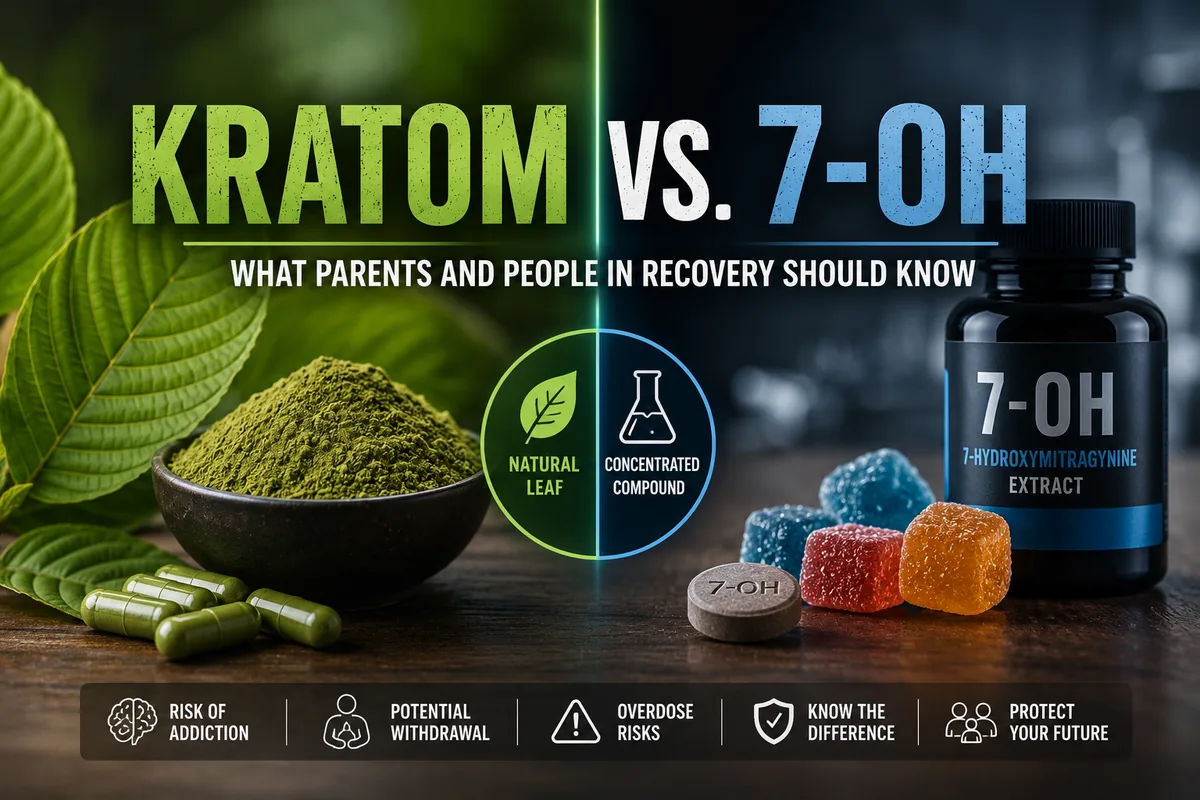
The difference between kratom vs 7-OH can be confusing, especially when both products are sold as Kratom Gummies, tablets, powders, or drink shots. Natural kratom leaf contains many plant compounds, while 7-OH products may contain highly concentrated amounts of one opioid-like chemical. Both can lead to addiction, withdrawal, and other health problems, but concentrated products may carry greater and less predictable risks. Understanding the label matters because a brightly colored gummy sold at a gas station may be very different from traditional kratom tea.
Kratom vs. 7-OH: What Is the Difference?
Kratom is made from the leaves of Mitragyna speciosa, a tree native to Southeast Asia. Traditionally, people chewed the leaves or brewed them into tea. Kratom’s main active compound is mitragynine, although the plant contains many other alkaloids.
Mitragynine and 7-hydroxymitragynine, often shortened to 7-OH, both interact with opioid receptors in the brain. Kratom can produce stimulant-like effects, such as increased energy and alertness, as well as opioid-like effects, including relaxation, pain relief, and drowsiness.
Natural kratom leaf normally contains only trace amounts of 7-OH. Concentrated kratom products, however, may contain added, enhanced, or manufactured 7-OH at levels far beyond what occurs naturally in the plant.
The FDA describes concentrated 7-OH tablets, gummies, drink mixes, and shots as novel, potent opioid products. The agency recommends avoiding them because they have not been proven safe or effective for any use.
This means that a package labeled “kratom” may not tell the whole story. Parents and people in recovery should look for terms such as:
- 7-OH or 7-hydroxymitragynine
- Enhanced or concentrated alkaloids
- Extract, isolate, or extra strength
- Milligrams of 7-OH per serving
- Multiple servings in one gummy, tablet, or shot
Some Kratom Gummies may contain ordinary leaf powder or a broad kratom extract. Others are primarily concentrated 7-OH products. They should not be treated as interchangeable.
Are Kratom and 7-OH Opioids?
Kratom is a complex botanical, not a single traditional opioid drug. However, some of its active compounds affect the same brain receptors involved in opioid effects.
Concentrated 7-OH is more directly opioid-like. The FDA warns that exposure may cause serious harm and has received reports involving addiction, anxiety, depression, stomach problems, insomnia, seizures, and withdrawal.
A person may believe a store-bought product is safer than heroin, fentanyl, or prescription pain pills. Legal availability does not prove safety. Product strength may vary, and some items may contain ingredients that are missing from the label.
Kratom-related fatal overdose from the plant alone appears to be rare, according to the National Center for Complementary and Integrative Health. However, severe effects and deaths have been linked to kratom combined with other substances. Reported serious problems include seizures, high blood pressure, liver injury, and contamination with heavy metals or harmful bacteria.
The risk may rise when kratom or 7-OH is mixed with alcohol, opioids, benzodiazepines, sleeping medications, or other sedating drugs.
Warning Signs of Addiction and Withdrawal
Regular use of kratom or concentrated 7-OH may lead to tolerance. This means a person needs larger or more frequent amounts to feel the same effects. Physical dependence may develop when the body adapts to repeated exposure.
Possible signs of addiction include:
- Using more often than planned
- Needing increasingly strong extracts
- Spending excessive money on gummies or shots
- Hiding packages from family members
- Using to prevent feeling sick
- Trying to stop but repeatedly returning to use
- Continuing despite health, work, or relationship problems
Kratom and 7-OH withdrawal may include restlessness, irritability, anxiety, insomnia, sweating, body aches, fatigue, stomach problems, and strong cravings. The FDA specifically reports cold sweats, fatigue, irritability, restlessness, and body aches with concentrated 7-OH products.
Someone using high-potency products every day should speak with a medical or addiction professional before attempting to quit alone. A clinician can evaluate the product, amount used, other substances involved, and whether supervised care is appropriate.
Call 911 if someone is unconscious, cannot be awakened, has slow or difficult breathing, experiences a seizure, or becomes severely confused. Give naloxone when an opioid exposure is possible and it is available, but do not delay emergency care.
What the New Mitragynine Research Actually Means
Balanced coverage is important because researchers are studying whether a purified kratom compound could someday have medical value.
In June 2026, the National Institutes of Health announced that an FDA Investigational New Drug application had taken effect for a purified formulation of mitragynine. This allows researchers to begin a phase 1 human study examining its safety and tolerability as a possible future treatment for opioid use disorder.
That announcement does not mean retail kratom has been proven to treat opioid addiction. It also does not prove that Kratom Gummies, extracts, or concentrated 7-OH products are safe.
The planned trial involves a carefully purified compound, controlled dosing, medical supervision, and scientific monitoring. Store products may contain varying mixtures and concentrations. NIH also emphasized that mitragynine in isolation had not yet been studied in humans through this planned trial when the announcement was made.
Researchers can responsibly study mitragynine while public-health officials warn against concentrated 7-OH. Those positions are not contradictory. One concerns a controlled experimental medicine; the other concerns potent commercial products sold without established safety standards.
For parents and people in recovery, the message is simple: read the entire label, do not assume all kratom products are alike, and take escalating use seriously. Recovery should be supported with proven medical care—not an unpredictable product marketed beside candy and energy drinks.


