





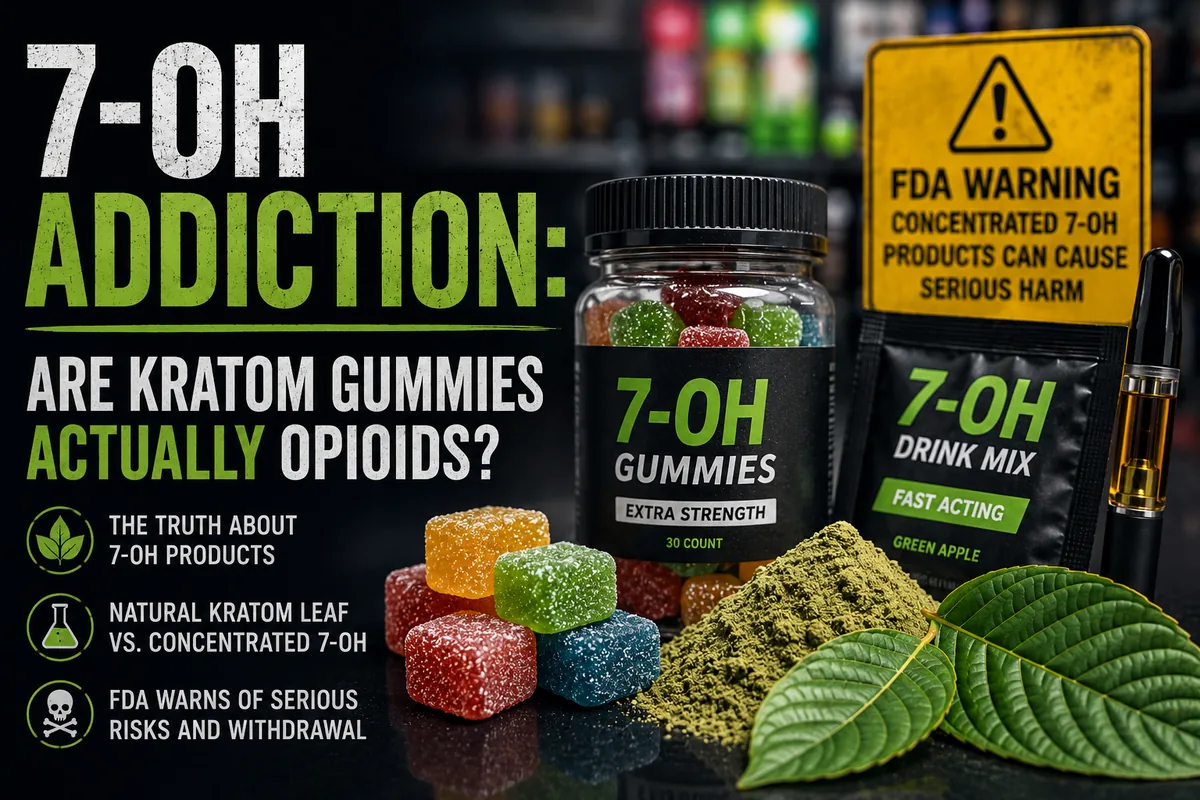
7-OH addiction is becoming a serious concern as highly concentrated kratom gummies, tablets, shots, and drink mixes appear in vape shops, gas stations, and convenience stores. These products are very different from traditional kratom leaf. They may deliver much larger amounts of 7-hydroxymitragynine, a compound that acts on opioid receptors and can cause tolerance, dependence, and 7-hydroxymitragynine withdrawal. The FDA describes concentrated 7-OH products as “novel potent opioid products” and advises consumers to avoid them.
What Is 7-OH?
7-OH is short for 7-hydroxymitragynine. It is one of the active alkaloids associated with kratom, a tree native to Southeast Asia. Traditional use has involved chewing fresh leaves or brewing them as tea. Natural kratom leaf contains mitragynine as its main alkaloid and only trace amounts of 7-OH.
That small amount matters because 7-OH interacts strongly with mu-opioid receptors in the brain. These are the same receptor systems affected by drugs such as morphine, heroin, and fentanyl. Laboratory research indicates that 7-OH has stronger opioid-receptor activity than mitragynine, the main compound in ordinary kratom leaf.
This does not mean that a cup of traditional kratom tea is identical to fentanyl. It does mean that concentrated 7-OH is not simply another mild herbal supplement.
Natural Kratom Leaf vs. Concentrated 7-OH Products
The key difference is concentration.
Natural kratom leaf contains a mixture of many plant compounds. Its effects can vary, and it can still cause side effects, dependence, and withdrawal. Kratom has not been approved by the FDA to treat pain, anxiety, opioid withdrawal, or any other medical condition.
Concentrated 7-OH products are different. Manufacturers may extract, enhance, or chemically produce far more 7-OH than occurs naturally in the leaf. The result may be sold as a fruit-flavored gummy, chewable tablet, dissolvable strip, shot, powder, or drink mix. Bright packaging and candy-like flavors can make the product appear harmless even when it contains a powerful opioid-like substance.
The FDA has warned that these products are readily available online and in smoke shops, gas stations, convenience stores, and corner stores. In 2025, the agency sent warning letters to seven companies that were marketing concentrated 7-OH products. The FDA later worked with federal authorities to seize approximately 73,000 units valued at about $1 million.
Are 7-OH Gummies Actually Opioids?
Pharmacologically, yes—concentrated 7-OH products act as opioids.
The word “opioid” describes substances that activate opioid receptors. An opioid does not have to come from the poppy plant or be prescribed by a doctor. Because 7-OH strongly activates mu-opioid receptors, the FDA refers to concentrated 7-OH products as potent opioids.
However, there is an important distinction. Natural kratom leaf is a complex botanical product containing only trace levels of 7-OH. A gummy or tablet designed to deliver enhanced 7-OH is closer to a concentrated drug product than to traditional leaf tea.
Federal regulators are now making that distinction as well. In July 2026, the DEA began the process of temporarily placing 7-OH above a proposed concentration threshold into Schedule I. The announced action targets concentrated and synthetic 7-OH products, not botanical kratom containing only naturally occurring trace levels. As of July 15, 2026, the temporary scheduling order had not yet taken effect.
Signs of 7-OH Addiction and 7-Hydroxymitragynine Withdrawal
Frequent 7-OH use can cause tolerance, meaning a person needs larger or more frequent amounts to experience the same effect. Dependence may develop when the brain and body adapt to regular exposure. Eventually, someone may take 7-OH simply to avoid feeling sick.
Possible signs of 7-OH addiction include:
- Taking larger or more frequent doses
- Trying and failing to reduce use
- Spending excessive money on gummies or tablets
- Hiding use from family and friends
- Feeling unable to work, sleep, or function without 7-OH
- Continuing despite health, financial, or relationship problems
The FDA has received reports involving addiction and withdrawal. Reported 7-hydroxymitragynine withdrawal symptoms include restlessness, body aches, fatigue, irritability, insomnia, and cold sweats. Reports connected to 7-OH products have also included anxiety, depression, stomach problems, and seizures.
Do not assume that a product is safe simply because it was purchased legally at a convenience store. The strength of concentrated products may vary, and some may contain additional active compounds. A healthcare professional can evaluate the symptoms and help create a safer withdrawal plan.
Treatment and Recovery From 7-OH Addiction
Someone struggling with 7-OH addiction deserves treatment, not shame. A clinical assessment can determine how much is being used, whether other substances are involved, and whether medically supervised withdrawal is needed.
Call 911 when someone is unconscious, cannot be awakened, has trouble breathing, experiences a seizure, or appears severely confused. The Poison Help Line can also be reached at 1-800-222-1222 in the United States.
Recovery may include medical monitoring, behavioral treatment, peer support, and treatment for an underlying opioid use disorder when appropriate. The most important first step is being honest about the exact product, dose, and frequency of use.
Natural kratom leaf and concentrated 7-OH are not the same product. The fact that 7-OH gummies are sold beside energy drinks does not make them safe. When use becomes difficult to control, professional help can prevent the consequences from becoming more severe.


